Building a Portfolio of Forex EAs:
Diversification Across Pairs, Timeframes & Strategies
How to combine multiple Expert Advisors with different logic to reduce drawdown, smooth your equity curve, and trade with professional-grade consistency.
Most traders who discover Forex Expert Advisors make the same first mistake: they find one EA they love, load it on a single chart, and expect it to carry their account forever. It won't. Markets evolve. Strategies that thrive in trending conditions bleed in ranging markets. But what if you built a coordinated team of EAs — each with a different role, a different pair, and a different timeframe — so that while one stumbles, others carry the weight?
- Why Relying on a Single EA Is Risky
- The 3 Pillars of EA Portfolio Diversification
- Diversifying Across Currency Pairs
- Diversifying Across Timeframes
- Diversifying Across Strategies
- A Real-World Example EA Portfolio
- Risk Management Across Multiple EAs
- Common Mistakes to Avoid
- Tools & Resources
- Join Nexus Forex Trading
Why Relying on a Single EA Is a Recipe for Volatility
Imagine hiring a single specialist to run your entire company. When they're performing at their best, everything hums. But when they're sick, on holiday, or simply out of their depth — the whole operation suffers. That's exactly the risk of the single-EA approach.
Every Forex EA is built around a core assumption about how the market behaves. A trend-following EA assumes markets move directionally for extended periods. A mean-reversion EA assumes prices always snap back to equilibrium. A scalping EA assumes short bursts of momentum can be captured for small, frequent gains. None of these assumptions hold true 100% of the time.
"Professional traders achieve consistency through diversification, portfolio-based EA management, and continuous optimisation — not by relying on a single automated strategy."
The result? Even the best-performing EAs go through extended drawdown periods — sometimes lasting weeks or months — simply because their underlying market assumption has temporarily broken down. If your entire account depends on that one EA, those drawdown periods feel catastrophic and often cause traders to panic-quit just before conditions improve.
The solution isn't to find a "perfect" EA. It's to build a portfolio of EAs where the weaknesses of one are compensated by the strengths of another. This is the foundational principle behind professional algorithmic trading desks worldwide.
The 3 Pillars of EA Portfolio Diversification
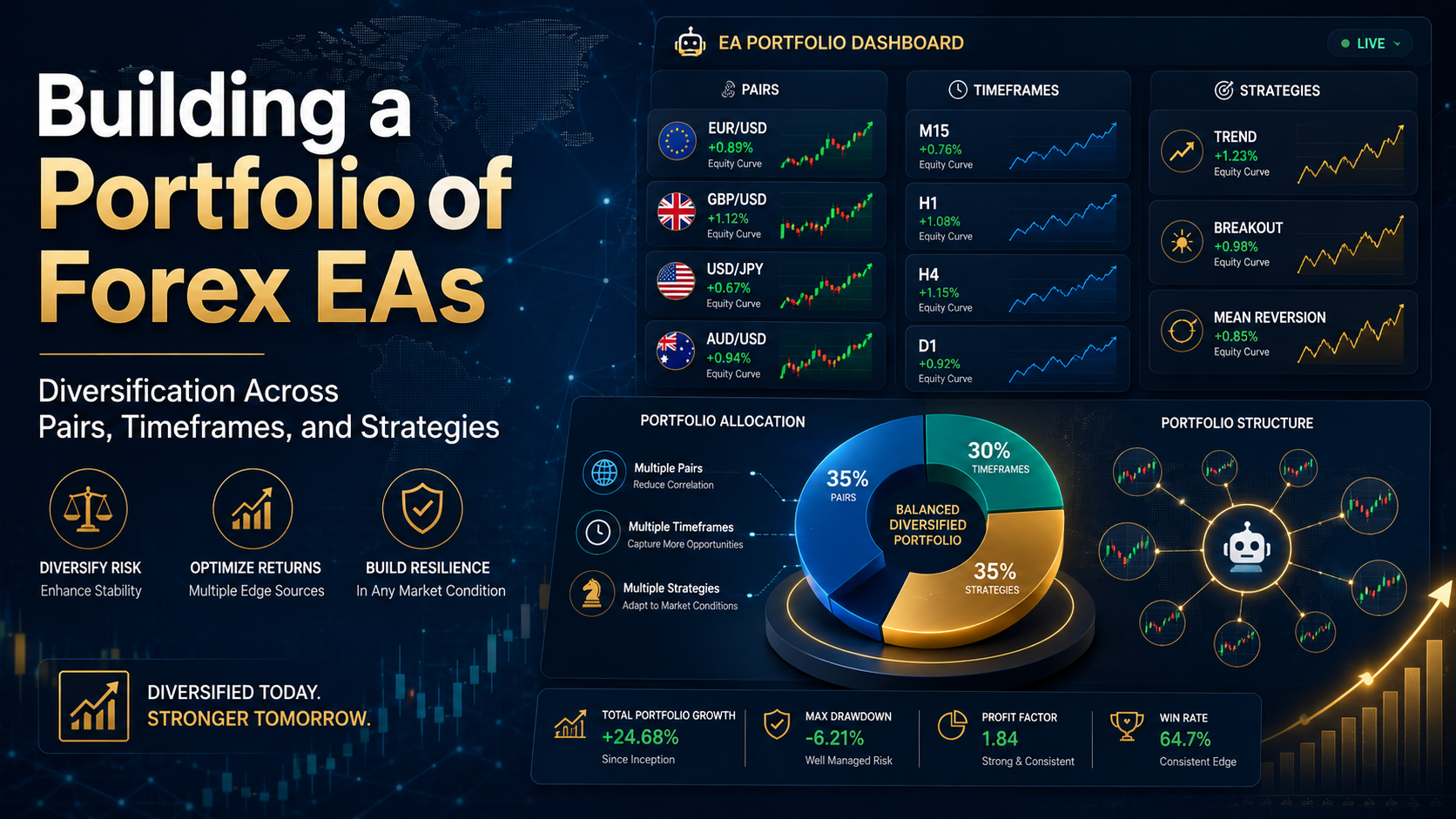
True EA portfolio diversification operates across three distinct dimensions. Think of them as the three legs of a stool — remove any one and the whole structure becomes unstable.
Currency Pair Diversification
Spreading exposure across pairs with low correlation so that a shock in one market doesn't devastate your entire account.
Timeframe Diversification
Running EAs across M5, H1, H4, and D1 so your portfolio captures opportunities across different momentum cycles.
Strategy Diversification
Combining trend-followers, mean-reversion systems, and scalpers so that all market conditions are represented.
When these three pillars work together, the result is a smoother equity curve — one where profits from well-performing EAs offset the temporary slumps of others, creating far more consistent month-to-month performance than any single EA could deliver.
Pillar 1 — Diversifying Across Currency Pairs
Understanding Correlation: The Hidden Risk in Your EA Portfolio
Not all currency pairs are created equal when it comes to diversification. The key metric to understand is correlation — a statistical measure of how closely two pairs move together. Correlations range from +1.0 (perfectly in sync) to -1.0 (perfectly opposite), with 0 indicating no relationship.
Running five different EAs on USD-heavy pairs like EUR/USD, GBP/USD, and AUD/USD might feel diversified — but all three share the US Dollar as a base, meaning a major dollar event (Fed rate decision, NFP data) can move all three simultaneously and stack your losses. This is false diversification.
Real pair diversification means selecting currency pairs that respond to different macroeconomic drivers. Consider grouping pairs into uncorrelated buckets:
| Pair | Dominant Driver | Session | Typical Behaviour | Portfolio Role |
|---|---|---|---|---|
| EUR/USD | ECB / Fed policy | London / NY | Strongly trending | Core Trend |
| GBP/USD | BoE / UK data | London | High volatility, momentum | Core Trend |
| USD/JPY | Risk sentiment / BoJ | Tokyo / NY | Safe-haven driven | Hedge / Balance |
| EUR/JPY | Risk appetite / flows | Tokyo / London | Momentum, trend | Cross Exposure |
| AUD/CAD | Commodities / China | Sydney / NY | Range-bound, mean-revert | Mean Reversion |
| GBP/CAD | Oil / BoC divergence | London / NY | Wide range, volatile | Scalp / Range |
The golden rule: measure correlation between your EAs' equity curves, not just between the pairs themselves. Two EAs on different pairs with similar logic (e.g. both trend-following) may still produce highly correlated drawdowns. The correlation that truly matters is the return correlation between strategies in live trading.
A practical tool for checking current pair correlations is the Myfxbook Correlation Tool, which provides real-time correlation data across all major and minor pairs.
Pillar 2 — Diversifying Across Timeframes
The same currency pair can behave very differently depending on which timeframe you're trading. A EUR/USD trend-follower on the H4 chart is capturing multi-day momentum swings. A EUR/USD scalper on the M5 chart is capturing 5-pip bursts of intraday momentum. These two EAs are essentially operating in different "markets" — even though they're trading the same instrument.
- M1–M15 (Scalping): High trade frequency, small targets, profits accrue quickly during volatility windows. Best during London/NY overlap.
- H1–H4 (Intraday Swing): Moderate trade frequency, captures intraday to multi-day trends. Core of most EA portfolios.
- H4–D1 (Position/Swing): Low trade frequency but large pip targets. Profits slowly but contributes stability. Excellent during macro-trend environments.
Running EAs across multiple timeframes means your portfolio is active across multiple momentum cycles simultaneously. While your H4 trend EA is waiting patiently for a high-conviction setup to mature, your M15 scalper may already be executing dozens of profitable trades. This temporal diversification means your equity curve grows more consistently rather than in large, lumpy chunks.
Pair your short-timeframe scalping EAs specifically with your highest-liquidity trading sessions (London open: 08:00–10:00 GMT, NY open: 13:00–15:00 GMT). Schedule medium-timeframe EAs to be active across the full London session, and allow your longer-timeframe EAs to run continuously, 24 hours a day.
Pillar 3 — Diversifying Across Strategies
This is the most intellectually important dimension of EA portfolio construction, because it directly addresses the core market risk: no single market condition persists forever. Here are the four primary EA strategy types and the market conditions where each thrives:
1. Trend-Following EAs
These EAs use indicators like Moving Averages, MACD, or ADX to identify and ride directional market momentum. They're highly profitable during sustained trends but suffer in sideways, choppy markets. Example pairs: EUR/USD (H4), GBP/USD (H1), USD/JPY (H4).
2. Mean-Reversion EAs
Operating on the statistical principle that prices always return to their average, these EAs excel during range-bound or consolidating markets — exactly when trend-followers struggle. They typically trade cross pairs like EUR/NZD, AUD/NZD, or EUR/AUD during the quiet Asian session when volatility compresses. This is the natural complement to trend-following EAs in a balanced portfolio.
3. Scalping EAs
High-frequency, tight-target EAs that capitalise on short bursts of momentum. They generate income consistently across most market conditions as long as spreads remain tight. Running a scalper on EUR/USD or GBP/USD during peak liquidity hours provides a steady trickle of profits to smooth your overall equity curve between larger trend trades.
4. Breakout EAs
These EAs wait for price to break out of defined ranges or consolidation zones, then ride the expansion in volatility. They pair beautifully with mean-reversion systems — when the range breaks, the breakout EA fires while the mean-reversion EA steps back.
"The goal isn't to find the perfect strategy. The goal is to build a portfolio where the weaknesses of one strategy are covered by the strengths of another."
A Real-World Example EA Portfolio
Let's make this concrete. Below is an example of a well-diversified four-EA portfolio that covers multiple pairs, timeframes, and strategy types. This is the kind of portfolio structure used by professional algorithmic traders to create robust, all-weather automated trading systems.
| # | EA Role | Pair | Timeframe | Strategy Type | Active Session | Risk Per Trade |
|---|---|---|---|---|---|---|
| 1 | Core Trend | EUR/USD | H4 | Trend-Following | London / NY | 1.0% |
| 2 | Momentum Engine | GBP/USD | H1 | Trend-Following | London | 0.75% |
| 3 | Night Stabiliser | EUR/NZD | M15 | Mean-Reversion | Asian Session | 0.5% |
| 4 | Volatility Harvester | GBP/JPY | M30 | Breakout Scalp | London Open | 0.75% |
Why this works: EA #1 and EA #2 are both trend-following, but they trade different pairs with distinct macroeconomic drivers (EUR is ECB-sensitive, GBP is BoE-sensitive), reducing their correlation significantly. EA #3 operates during the Asian session when EAs #1 and #2 are largely idle — providing continuous overnight account activity. EA #4 activates specifically at the London open, a period of high expansion volatility that the other EAs don't specifically target.
Total maximum simultaneous risk across all four EAs: 3% per round (if all four trigger simultaneously, which is rare due to session separation). Compare this to a single-EA approach where a bad trade can cost 2% all at once with no offsetting activity from other strategies.
Risk Management Across Multiple EAs
Adding more EAs doesn't automatically reduce risk — it can actually amplify risk if not managed correctly. Here are the essential principles for portfolio-level risk management:
Assign Each EA a Unique Magic Number
In MetaTrader, every EA must use a unique Magic Number to ensure it only manages its own trades. Overlapping magic numbers cause EAs to interfere with each other's positions — a critical bug in multi-EA portfolios that can lead to unintended closures or doubling of positions.
Set a Hard Portfolio-Level Drawdown Limit
Decide in advance: what is the maximum account drawdown you will tolerate before pausing all EAs? A common professional threshold is 15–20% portfolio drawdown. Use a portfolio monitoring tool or a master EA to enforce this automatically.
Allocate Risk Proportionally, Not Equally
Your highest-confidence, longest-track-record EA deserves the highest risk allocation. New or unproven EAs should start at 0.25–0.5% risk per trade until they demonstrate live performance. Don't divide capital equally just because you have multiple EAs — size each position to its proven Sharpe ratio.
Monitor Equity Curve Correlation Monthly
Market regimes change. Two EAs that were uncorrelated in 2024 may become highly correlated in 2025 if their underlying pairs begin moving together. Review your portfolio's inter-EA correlation monthly using tools like Myfxbook or a custom spreadsheet and rebalance as needed.
Avoid Over-Leveraging During High-Correlation Events
During major news events (FOMC, NFP, central bank meetings), correlations across all USD pairs spike dramatically. Consider switching all USD-exposed EAs to a "news filter" mode during these periods, or manually reducing lot sizes to prevent simultaneous losses stacking across multiple EAs.
Common Mistakes Traders Make When Building EA Portfolios
Optimising each EA to perfection on historical data creates strategies that fit the past perfectly but fail in live markets. Always validate EA performance on out-of-sample data — data the EA has never "seen" — before adding it to your live portfolio.
More EAs is not always better. Running 10 or 15 EAs simultaneously becomes nearly impossible to monitor effectively, consumes excessive margin, and often produces diminishing diversification benefits after the first 4–6 well-selected EAs. Start small, prove performance, then scale gradually.
A multi-EA portfolio generates far more trades than a single EA. Each trade incurs a spread cost. Scalping EAs are especially sensitive to execution quality — a 0.5 pip difference in average spread can turn a profitable scalping EA into a losing one. Always test on a low-spread ECN broker with verified execution data.
Running EUR/USD, GBP/USD, and AUD/USD simultaneously gives you three positions with significant USD correlation. True diversification requires selecting pairs from genuinely different macro regimes — dollar pairs, yen crosses, commodity pairs, and European crosses each represent meaningfully different risk exposures.
Before adding any new EA to your live portfolio, run it in parallel on a demo account for a minimum of 60–90 days while your live portfolio runs. Only promote it to live trading once it demonstrates consistent performance that genuinely improves your overall portfolio's Sharpe ratio — not just its own isolated metrics.
Essential Tools & Resources for EA Portfolio Builders
Building and managing a multi-EA portfolio requires the right infrastructure. These are the platforms and resources professional algorithmic traders rely on:
The Bottom Line: Think Like a Portfolio Manager, Not a Single-Trade Gambler
The traders who build long-term, sustainable automated trading income are not those who find the single greatest EA ever created. They are the traders who think systematically — who understand that market conditions are constantly rotating, that no single strategy wins in every environment, and that the only way to create truly consistent returns is to build a portfolio where the whole is greater than the sum of its parts.
When your trend-following EA on EUR/USD is grinding through a drawdown because markets have turned choppy, your mean-reversion EA on the Asian-session crosses should be quietly accumulating profits. When your overnight scalper hits a great week, those returns cushion your account even if your longer-timeframe systems are sitting in flat trades. This is what a smooth equity curve looks like in practice — not perfection, but continuous, balanced forward progress.
Start simple. Pick two or three EAs with genuinely different logic and pairs. Prove the combination on demo for 60 days. Measure the correlation between their equity curves. If it's low (below 0.3), you have real diversification. Then — and only then — go live, and scale methodically from there.
The professional algorithmic traders don't have a secret EA. They have a process. And now, so do you.
Join Nexus Forex Trading & Access Our Professional EUR/USD & GBP/USD EA Portfolio
Stop guessing. Start trading with battle-tested, professionally built Expert Advisors specifically designed for EUR/USD and GBP/USD — the two most liquid pairs in the world. Perfect for both solo traders and portfolio builders.
Automated trading involves risk. Past performance is not indicative of future results.