
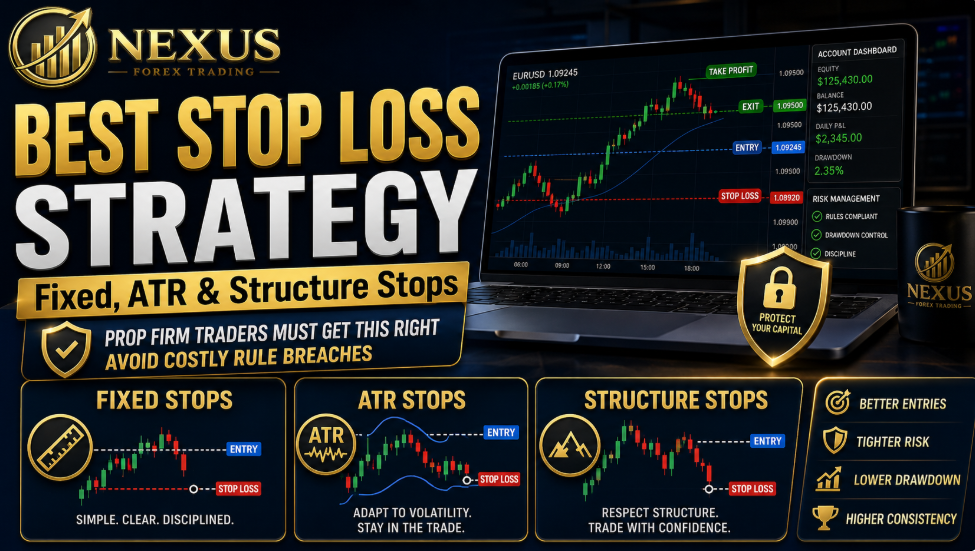
Learn the Best Stop Loss Strategy for Prop Firm Trading
The best stop loss strategy for prop firm trading is not simply the tightest stop, the widest stop, or the most aggressive trailing stop. It is the stop loss method that protects the account, respects the firm’s drawdown rules, gives the trade enough room to work, and keeps your position size small enough to survive a normal losing streak.
In this guide, we break down fixed stops, ATR stops, structure-based stops, hybrid stop placement, and one of the most misunderstood areas of funded trading: when not to trail your stop under strict drawdown rules.
- Why prop firm stop losses are different from normal retail trading
- How fixed stop losses work and when they make sense
- How to use ATR stops for volatility-adjusted risk
- How structure-based stops protect trade logic
- Why trailing stops can damage prop firm performance
- A practical stop loss framework for funded forex traders
- How to reduce emotional decision-making with rules-based execution
Why Stop Loss Strategy Matters More in Prop Firm Trading
In normal retail forex trading, a poor stop loss strategy can damage your account slowly. In prop firm trading, it can end the challenge immediately. That is the key difference. You are not only managing market risk. You are managing rule risk.
Most prop firm traders focus too much on the profit target and not enough on the account failure line. They ask, “How can I pass this challenge quickly?” when the better question is, “How can I make sure one bad day does not remove me from the game?” A strong stop loss strategy is the bridge between those two questions.
Prop firms commonly apply daily loss limits and maximum loss limits. For example, FTMO explains that its Maximum Daily Loss rule includes both closed results and floating open position profit or loss, meaning an open trade can contribute to a breach even before it is closed. FTMO also describes separate Maximum Loss rules that protect the overall account limit. The5ers’ High Stakes model similarly references a maximum account loss and daily drawdown framework. Always check the current rule page for your specific firm and account type before trading, because rules can change and different programs often calculate drawdown differently.
Useful official resources include the FTMO pages on Maximum Daily Loss, Maximum Loss, and The5ers’ High Stakes Program rules.
The Three Main Stop Loss Methods for Prop Firm Forex Trading
There are many variations of stop loss placement, but most practical strategies fall into three categories: fixed stops, ATR stops, and structure-based stops. Each has strengths. Each has weaknesses. The best funded traders often combine them rather than relying on one method blindly.
| Stop Loss Type | Best For | Main Risk |
|---|---|---|
| Fixed Stop | Simple, repeatable systems where the same pip distance is used consistently. | May be too tight in volatile conditions or too wide in quiet markets. |
| ATR Stop | Volatility-adjusted trading where stop distance changes with market movement. | Can become too wide during high-volatility news periods unless position size is reduced. |
| Structure-Based Stop | Price action traders using swing highs, swing lows, support, resistance, or breakouts. | Can be subjective unless the trader has clear rules for identifying structure. |
1. Fixed Stop Loss Strategy
A fixed stop loss uses the same stop distance on each trade. For example, a trader might always use a 20-pip stop on EURUSD or a 35-pip stop on GBPUSD. The appeal is obvious: it is simple, easy to test, and easy to size. If you know your stop is always 25 pips, you can quickly calculate how much you are risking per trade.
Example: Fixed Stop on a Prop Firm Account
Imagine a trader has a $100,000 prop firm challenge account with a 5% daily loss limit. That means the trader cannot allow the account to lose $5,000 in a day, including floating losses where applicable. A sensible trader would not risk anywhere near that full amount on one trade.
If the trader risks 0.5% per trade, the maximum planned loss is $500. If the fixed stop is 25 pips, the position size must be calculated so that 25 pips equals approximately $500 before spread and commission. This is the proper way to use a fixed stop: the stop distance comes first, then the lot size is adjusted around it.
The common mistake is doing the opposite. Many traders choose the lot size first, then place a random stop loss and hope it works. That is dangerous in prop firm trading because a few badly sized trades can quickly push the account near the daily drawdown limit.
When Fixed Stops Work Well
- The trading strategy has been tested with the same stop distance across many trades.
- The trader focuses on one or two pairs with relatively stable behaviour.
- The system avoids major news events where normal pip ranges can expand suddenly.
- The trader wants clean, repeatable risk measurement.
When Fixed Stops Fail
Fixed stops fail when market volatility changes and the trader refuses to adapt. A 20-pip stop may be reasonable on EURUSD during quiet conditions, but it can be far too tight during high-impact news. The same stop may also be too wide during extremely quiet periods, creating poor reward-to-risk and inefficient capital use.
Fixed stops are not bad. Blind fixed stops are bad. If you use fixed stops, review performance across quiet, normal, and volatile sessions. A strategy that only works in one volatility environment may not be stable enough for a funded challenge.
2. ATR Stop Loss Strategy
ATR stands for Average True Range. It is a volatility indicator that measures how much price has been moving over a selected period. Fidelity describes ATR as an average of true ranges and notes that ATR-based stops adapt to volatility rather than using a fixed dollar, point, or percentage stop.
Resource: Fidelity guide to Average True Range.
In practical forex trading, an ATR stop might be placed 1.5x, 2x, or 2.5x the current ATR away from entry. If EURUSD has a 14-period ATR of 10 pips on the chosen timeframe, a 2x ATR stop would be 20 pips. If volatility rises and ATR becomes 18 pips, the 2x ATR stop becomes 36 pips.
Example: ATR Stop on EURUSD
Suppose EURUSD is trading around a key intraday level and the 15-minute ATR is 8 pips. A trader using a 2x ATR stop would place the stop roughly 16 pips from entry. If the trader risks $300, the position size must be calculated so that 16 pips equals $300.
Now imagine the same setup appears before a major US inflation release and ATR expands to 18 pips. A 2x ATR stop is now 36 pips. The trader has two choices: reduce lot size so the dollar risk remains the same, or skip the trade because volatility is too high for the prop firm’s drawdown rules.
This is where many traders go wrong. They widen the stop but keep the same lot size. That does not reduce risk. It increases risk. A wider stop must normally mean a smaller position size.
Why ATR Stops Are Useful for Prop Firms
ATR stops are useful because they respond to the market. A prop firm trader needs to avoid random stop-outs, but also cannot allow unlimited drawdown. ATR helps balance those pressures. It gives the trade breathing room when the market is moving normally, while still creating a defined exit point.
ATR is especially helpful for EURUSD and GBPUSD because both pairs can move differently depending on the session. GBPUSD can be more volatile around UK data and London session flows. EURUSD can react sharply to European Central Bank commentary, US dollar repricing, inflation data, jobs data, and Federal Reserve expectations. A static stop may ignore these changing conditions.
The Prop Firm ATR Rule
3. Structure-Based Stop Loss Strategy
A structure-based stop uses the chart itself to decide where the trade idea is invalidated. Instead of saying “I will use 25 pips on every trade,” the trader asks, “Where would price need to go to prove this setup wrong?”
Common structure-based stop areas include:
- Below a swing low for a long trade
- Above a swing high for a short trade
- Beyond a support or resistance zone
- Past the other side of a breakout range
- Outside a trendline or channel structure
BabyPips has useful beginner-friendly resources on support and resistance and trading support and resistance.
Example: Structure Stop on GBPUSD
Imagine GBPUSD breaks above a previous London session high, pulls back, and then begins to hold that former resistance as support. A structure-based long setup might place the stop below the pullback low rather than using a random 20-pip stop.
If the stop is 28 pips away and the trader wants to risk $400, the lot size must be set so that 28 pips equals $400. If the structure stop is 65 pips away, the trader should either reduce position size heavily or avoid the trade. A technically valid stop can still be too expensive for a prop firm account.
The Strength of Structure-Based Stops
Structure-based stops are powerful because they connect risk to trade logic. A stop below a swing low is not random. It means the market has broken the level that supported the trade idea. A stop beyond resistance means the short trade has likely failed. This makes the stop loss part of the trading thesis rather than an emotional panic button.
The Weakness of Structure-Based Stops
The weakness is subjectivity. Two traders can look at the same chart and choose different swing points. One trader sees a clean support level. Another sees noise. For prop firm trading, subjectivity can be dangerous because emotional traders often move the stop after entry. The best solution is to define the rules before the trade is opened.
The Best Stop Loss Strategy Is Often a Hybrid
The most practical approach for prop firm trading is often a hybrid stop. This means you use structure to identify the invalidation point, ATR to check whether the stop distance is reasonable for current volatility, and fixed account risk to control the financial damage if the trade fails.
A hybrid framework might look like this:
- Identify the trade setup.
- Mark the structural invalidation level.
- Check the ATR to see whether the stop distance is normal or excessive.
- Calculate position size based on the maximum account risk.
- Check whether the trade could threaten the daily drawdown rule.
- Enter only if the trade passes all risk filters.
Example Hybrid Stop Framework
A trader sees a EURUSD long setup after a bullish breakout. The structural stop is 24 pips away. The current ATR suggests a normal stop should be between 18 and 30 pips, so the stop is reasonable. The trader’s rule is to risk 0.4% per trade. On a $100,000 account, that is $400.
The trader calculates lot size so that a 24-pip loss equals roughly $400. The trade is now aligned with structure, volatility, and prop firm risk control. This is far stronger than entering first and deciding the stop later.
Why Trailing Stops Can Be Dangerous Under Prop Firm Rules
Trailing stops sound attractive. They promise to protect profits automatically as price moves in your favour. MetaTrader 5 documentation explains that trailing stops can make the stop loss follow price automatically, although standard trailing stop functionality is handled in the trading platform rather than on the server. That matters because platform connection, VPS reliability, and setup can affect whether trailing behaviour functions as expected.
Resource: MetaTrader 5 trading operations and trailing stop documentation.
The problem is not that trailing stops are useless. The problem is that many traders trail too early, too tightly, or without understanding how the firm calculates drawdown. In prop firm trading, a badly designed trailing stop can reduce average winners, increase emotional re-entries, and create a cycle where the trader takes many small losses and scratches without ever allowing a clean winner to develop.
When Not to Trail Your Stop
You should be very careful about trailing your stop in the following situations:
- Before price has cleared meaningful structure: If you trail too early, normal pullbacks can stop you out before the trade develops.
- During choppy market conditions: A tight trailing stop in a range often creates repeated small losses.
- When the daily drawdown buffer is already reduced: If you are close to the daily loss limit, the better decision may be to stop trading rather than trail aggressively and re-enter repeatedly.
- When the trade has a clear fixed target: Some strategies perform better with a planned take profit than with constant trailing.
- During high-impact news: Fast spreads, slippage, and volatility can make trailing behaviour less reliable.
The Break-Even Trap
One of the biggest mistakes prop firm traders make is moving the stop to break even too quickly. It feels responsible, but it can damage the strategy. If a trade normally needs room to breathe, moving to break even after a small move may turn a profitable system into a flat or losing one.
Break-even stops are useful when price has genuinely moved far enough to change the risk profile of the trade. They are not useful when they are used to calm nerves. If you constantly move stops because you feel uncomfortable, the problem may be position size, not stop placement.
How Much Should You Risk Per Trade in a Prop Firm?
There is no perfect number for every trader, but prop firm risk should usually be conservative. Many traders fail because they risk too much relative to the drawdown rules. Even if a firm allows a 5% daily loss, that does not mean you should risk 2% or 3% per trade.
A practical range for many prop firm traders is 0.25% to 0.75% per trade, depending on strategy quality, number of trades per day, win rate, average reward-to-risk, and maximum expected losing streak. Traders running multiple positions or correlated pairs should be even more careful.
| Risk Per Trade | Use Case | Prop Firm Consideration |
|---|---|---|
| 0.25% | Very conservative, good for learning or protecting a funded account. | Allows more room for normal variance and losing streaks. |
| 0.50% | Balanced risk for many structured forex strategies. | Four consecutive losses equal roughly 2% before costs. |
| 1.00% | Aggressive for most prop firm traders. | A short losing streak can quickly threaten the daily loss limit. |
| 2.00%+ | Very aggressive challenge-passing attempt. | High risk of failing the account from normal market variance. |
A Practical Daily Drawdown Safety Rule
A smart prop firm trader does not wait until the official loss limit is reached. They create a personal loss limit that is tighter than the firm’s rule. For example, if the firm has a 5% daily loss limit, the trader may stop trading for the day after losing 1.5% or 2%.
This creates a safety buffer. It also reduces revenge trading. Most prop firm failures do not happen because of one normal losing trade. They happen because the trader loses, gets frustrated, increases size, moves stops, opens another trade, and then breaches the rule.
Stop Loss Mistakes That Fail Prop Firm Challenges
1. Using the Same Lot Size for Every Stop Distance
If your stop is 15 pips on one trade and 45 pips on another, the same lot size does not create the same risk. Wider stops need smaller position sizes.
2. Moving the Stop Further Away
Moving a stop further away after entry is one of the fastest ways to fail a funded account. It destroys the original risk calculation and turns a planned loss into an uncontrolled loss.
3. Trading Without Considering Correlation
If you are long EURUSD and short USDCHF, you may effectively be taking two trades against the US dollar. If both move against you, your real exposure may be larger than expected.
4. Ignoring Spread and Commission
A stop loss is not the only cost. Spread, commission, slippage, and swap can all affect real results. Under tight prop firm limits, these costs matter.
5. Trailing Every Trade the Same Way
A trend trade, breakout trade, reversal trade, and range trade may all need different management. One universal trailing rule may reduce performance if it does not match the strategy.
Best Stop Loss Strategy for Prop Firm Trading: Final Framework
The best stop loss strategy for prop firm trading is not one single magic setting. It is a complete risk process. A strong framework looks like this:
- Define the firm’s rules first: Know the daily loss, maximum loss, floating drawdown treatment, reset time, news rules, and position rules.
- Use a logical stop: Fixed, ATR, or structure-based stops can all work if they are tested and consistent.
- Size the trade from the stop: Stop distance determines lot size, not the other way around.
- Protect the daily buffer: Keep your personal loss limit below the firm’s official breach level.
- Avoid emotional trailing: Trail only when your strategy has a tested reason to trail.
- Stop trading when conditions are poor: No stop loss strategy can fix overtrading, revenge trading, or news gambling.
How Nexus Forex EA Fits a Risk-First Trading Mindset
Many traders are drawn to prop firms because they want structure. The problem is that manual trading can become emotional very quickly, especially when drawdown rules are strict. A rules-based trading approach can help reduce impulsive decision-making, inconsistent position management, and random trade entries.
Nexus Forex EA is designed for traders who want a structured automated approach to EURUSD and GBPUSD on MT4 and MT5. It does not remove market risk, and no Forex EA can guarantee profits or protect a trader from all losses. However, using a rules-based system can help traders think more clearly about execution, position sizing, drawdown, and repeatability.
Want to Test a Rules-Based EURUSD & GBPUSD Forex EA?
Get access to the Nexus Forex EA package and test a structured MT4/MT5 approach for EURUSD and GBPUSD. Review the setup, understand the risk controls, and make your own decision before trading live.
Get Free Nexus Forex EA Access →Recommended Resources
- FTMO Academy: Maximum Daily Loss
- FTMO Academy: Maximum Loss
- The5ers: High Stakes Program Rules
- Fidelity: Average True Range Indicator Guide
- BabyPips: Support and Resistance
- MetaTrader 5 Help: Trading Operations and Trailing Stops
Final Thoughts
The stop loss is where trading theory meets real risk. In prop firm trading, it is also where discipline is tested. A good entry can still fail if the stop is random. A good strategy can still fail if the position size is too large. A profitable trader can still lose a funded account if they ignore the daily drawdown rules.
Fixed stops can work when they are tested. ATR stops can work when lot size adjusts to volatility. Structure-based stops can work when the trader defines invalidation clearly. Trailing stops can work when they are part of the strategy, not an emotional reaction.
The best stop loss strategy for prop firm trading is the one that protects the account first and chases profit second. Survive the losing streaks, respect the rules, avoid emotional stop movement, and let only the best setups deserve your risk.
Risk disclaimer: Forex trading, prop firm trading, leveraged products and automated trading involve risk. Stop losses may not always execute at the expected price during fast markets, gaps, slippage, or low-liquidity conditions. This article is for educational purposes only and is not financial advice.