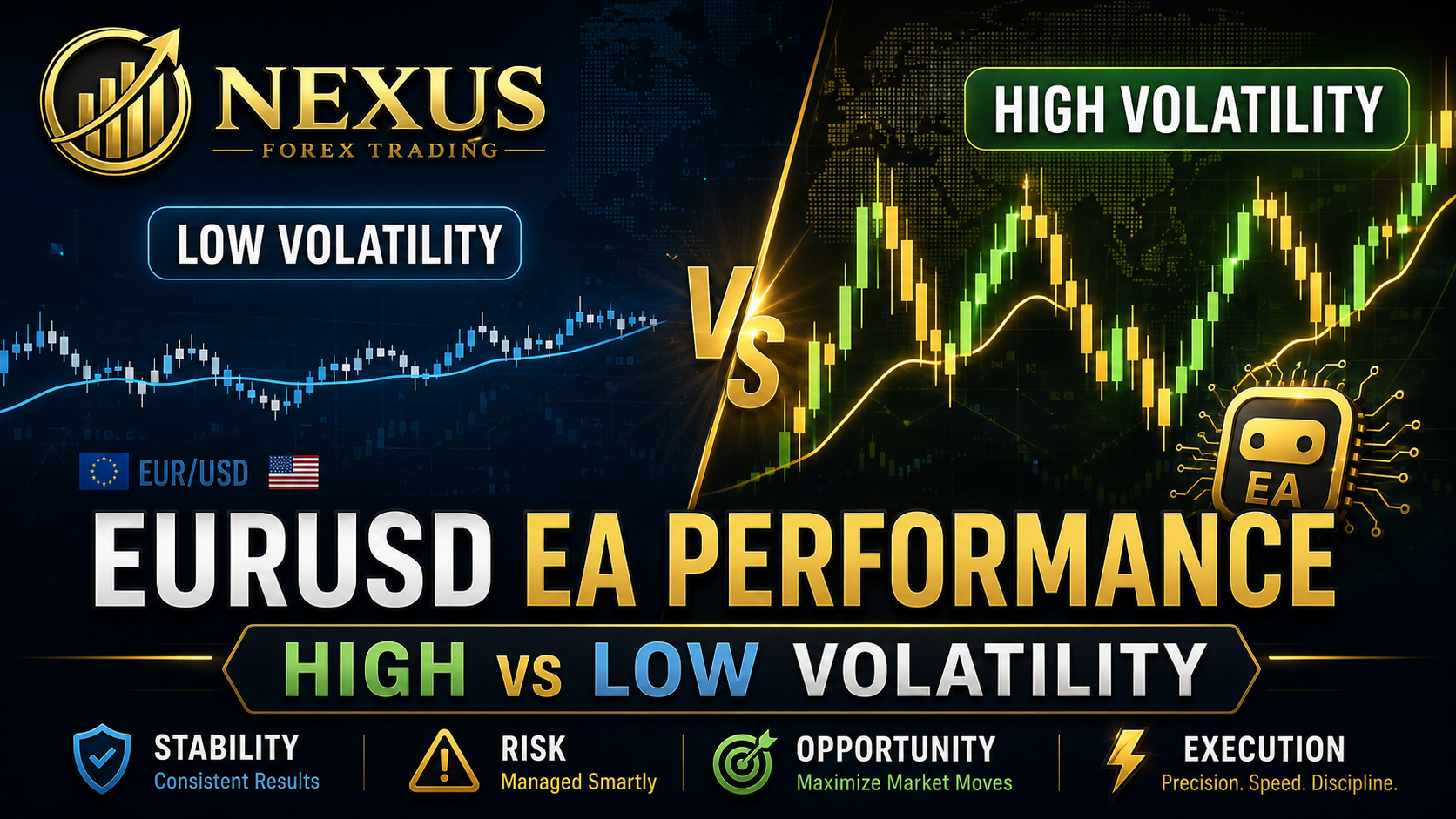
EURUSD EA Performance During High vs Low Volatility: When Automated Forex Trading Conditions Change
EURUSD is one of the most popular currency pairs for automated Forex trading because it is liquid, widely traded, heavily analysed and closely tied to global macroeconomic expectations. But for traders using a EURUSD EA, one question matters more than almost anything else: does a Forex EA perform better during high volatility or low volatility?
The honest answer is that it depends on the trading logic. Volatility is not automatically good or bad. What matters is whether the market movement fits the EA’s programmed rules.
Author: James Murphy
For Nexus Forex Trading, this is an important topic because EURUSD automated trading performance should never be judged only by headline profit. Traders need to understand the market conditions behind the results. A strong week during high volatility tells one story. A smaller positive week during flat conditions tells another. Both can be useful when reviewing real Forex EA live results.
This guide explains how EURUSD EA performance can change during high and low volatility, why ATR matters, what market events normally drive EURUSD movement, and how traders should think about automated trading during different volatility regimes.
What Does Volatility Mean in EURUSD Trading?
Volatility measures how much price moves over a specific period. In Forex, traders usually think about volatility in terms of pip movement, daily range, intraday swings, candle size, liquidity, spread behaviour and the speed of price changes.
High-Volatility EURUSD Conditions
- Wider daily ranges
- Larger candles
- Sharper breakouts
- Faster reversals
- Wider spreads around news
- More slippage risk
- Stronger reactions to economic data
Low-Volatility EURUSD Conditions
- Narrow daily ranges
- Smaller candles
- Fewer breakouts
- More sideways price action
- Lower trading frequency
- False starts
- Tighter but less productive ranges
A common way to measure volatility is Average True Range, usually shortened to ATR. ATR measures the average range of price movement over a selected number of periods. For example, a 14-period ATR on a daily chart gives traders a view of the average daily range over the most recent 14 candles.
Important point: ATR does not predict direction. It does not tell you whether EURUSD will rise or fall. It simply helps traders understand how much the pair has been moving.
That makes ATR useful for EA traders because volatility affects entries, stops, targets, trailing logic and trade frequency.
Why EURUSD Is Popular for Forex EAs
EURUSD is often the first pair traders consider when researching Forex robots or Expert Advisors. There are several reasons for that.
First, EURUSD is highly liquid. High liquidity matters because automated systems need stable execution, competitive spreads and enough market depth to enter and exit positions efficiently.
Second, EURUSD usually has competitive spreads compared with many minor or exotic pairs. Lower trading costs are important for automated strategies because EAs may take frequent trades, and even small increases in spread can reduce profitability.
Third, EURUSD is heavily driven by scheduled macroeconomic events. Federal Reserve policy, ECB policy, inflation data, labour-market releases, GDP, PMI reports and bond yields can all influence EURUSD direction. This creates both opportunity and risk for automated Forex trading.
Useful Authority Resources
Bank for International Settlements:
https://www.bis.org/
Federal Reserve:
https://www.federalreserve.gov/
European Central Bank:
https://www.ecb.europa.eu/
High Volatility: When EURUSD Moves Fast
High volatility usually occurs when traders are rapidly repricing expectations. For EURUSD, that often happens around:
- US Non-Farm Payrolls
- US CPI and PCE inflation
- Federal Reserve rate decisions
- ECB rate decisions
- Major central-bank speeches
- Eurozone inflation data
- Geopolitical shocks
- Bond-market stress
- Sudden changes in risk sentiment
During high volatility, EURUSD can move enough to create strong opportunities for an EA. If the system is designed to trade breakouts, momentum continuation or volatility expansion, these conditions can be favourable.
For example, after a major US inflation surprise, EURUSD may break through a support or resistance zone as traders adjust Federal Reserve rate expectations. A well-designed EA may identify the move, wait for its programmed criteria, and enter only if the setup matches its rules.
But high volatility also creates risk. Price can spike in one direction and reverse within minutes. Spreads may widen. Slippage can increase. Liquidity may thin around major news releases. A poor-quality EA may enter too late, chase the move, or get trapped by a false breakout.
Trader takeaway: High volatility is not automatically good. It is only useful if the EA can manage the conditions without taking excessive exposure.
Low Volatility: When EURUSD Goes Quiet
Low volatility can be frustrating for manual traders and automated systems. EURUSD may drift sideways for hours or days, especially when the market is waiting for major central-bank decisions or high-impact data.
In low-volatility conditions, a EURUSD EA may:
- trade less frequently;
- target smaller moves;
- close fewer trades;
- avoid low-quality setups;
- experience more false signals if its filters are weak;
- produce smaller weekly results.
That does not necessarily mean the EA is failing. A well-designed system should not force trades simply because the market is open. Sometimes the best trade is no trade.
Low volatility can be useful for certain mean-reversion strategies if price respects defined intraday ranges. However, if the range becomes too narrow, trading costs can become more important. A 1-pip spread matters much more when the average trade target is small than when EURUSD is moving strongly.
This is one reason traders should avoid judging a Forex EA only by trade count. Fewer trades can be a sign of discipline if the system is waiting for proper conditions.
ATR and Forex EAs: Why Average Range Matters
ATR is one of the most useful volatility tools for EA traders because it helps describe the market environment.
A rising ATR means EURUSD is moving more. A falling ATR means EURUSD is moving less. This can affect an EA in several ways.
| Volatility Condition | What ATR Suggests | Potential EA Impact |
|---|---|---|
| Rising ATR | EURUSD is moving more than usual. | More trade opportunities, but higher risk of wider spreads, slippage and reversals. |
| Falling ATR | EURUSD is moving less than usual. | Fewer opportunities, smaller targets and more inactive periods. |
| Extreme ATR spike | Market may be reacting to major news or shock risk. | Potential for strong movement, but also unstable execution and whipsaw risk. |
If an EA uses fixed stops and targets, high volatility may make those levels too tight. A stop that works well in a quiet market may be hit too easily during high-volatility news conditions. On the other hand, if the target is too small during strong movement, the EA may exit too early and miss the larger move.
If an EA uses ATR-based logic, its stop loss, take profit or filters may adapt to current market movement. For example, a system might use a wider stop when ATR expands and a smaller position size to keep risk controlled. That can be more flexible than using the same stop size in every market condition.
However, ATR is not a magic solution. ATR measures historical range. It cannot know whether the next candle will continue, reverse or spike because of a surprise data release. Traders should treat ATR as a volatility guide, not a prediction engine.
Examples of Market Events That Change EURUSD Volatility
EURUSD volatility often rises when markets reassess the gap between Federal Reserve and European Central Bank policy.
Federal Reserve Expectations
When Federal Reserve rate expectations rise, the US dollar often strengthens because higher US yields can attract capital. That can push EURUSD lower. When Fed expectations fall, EURUSD may rise as the dollar weakens.
For a EURUSD EA, that type of environment can create more movement and more trading opportunities, but it can also increase spread and reversal risk.
ECB Inflation Pressure
EURUSD is also sensitive to inflation inside the Eurozone. If Eurozone inflation surprises higher, traders may expect the ECB to stay restrictive. That can support the euro. If inflation cools faster than expected, the euro may weaken because traders may price a less hawkish ECB.
For EURUSD automated trading, inflation weeks can be important because they often produce volatility before and after the release. The EA does not trade “because inflation came out.” The event matters because it changes the trading environment.
Global Risk Sentiment
EURUSD can also move when global risk sentiment changes. The dollar may benefit during risk-off periods because investors often seek liquidity and safety. For automated systems, risk-off periods can create fast moves. That can be useful for momentum-based systems but dangerous for poorly controlled robots that add positions without understanding exposure.
Does a EURUSD EA Perform Better in High or Low Volatility?
A EURUSD EA usually needs enough volatility to create opportunity, but not so much volatility that price becomes chaotic.
Very low volatility can reduce opportunity. The EA may trade less, or trades may have smaller potential. If the system is not selective, it may get chopped up by narrow sideways movement.
Moderate volatility is often attractive because EURUSD has enough range to move, but conditions are not necessarily disorderly. This can allow the EA’s filters, entries and exits to function more consistently.
Very high volatility can produce larger gains but also larger risks. News spikes, widening spreads, slippage and whipsaw movement can all affect results. A strong EA may handle some of these conditions well, but no automated system is immune to market risk.
The best market condition for a Forex EA is not simply “high volatility.” It is tradable volatility: price is moving enough to create opportunity, but not so erratically that execution quality and risk control break down.
How Volatility Affects Win Rate, Profit Factor and Drawdown
Volatility can change the shape of EA performance metrics.
A low-volatility week may produce fewer trades and a higher win rate if the EA only takes clean, smaller setups. But the net profit may be modest because the market does not offer large moves.
A high-volatility week may produce more trades and larger profits, but the win rate may fall because price is moving faster and reversals are more violent. The EA may still perform well if average winners are large enough to outweigh losses.
This is why profit factor matters. Profit factor compares gross profit with gross loss. A system with a lower win rate can still be profitable if winners are meaningfully larger than losers. A system with a high win rate can still be weak if one large loss wipes out many small gains.
Drawdown must also be reviewed carefully. Higher returns are not automatically better if they require excessive exposure. A EURUSD EA that makes 10% with controlled drawdown may be more attractive than one that makes 20% while taking extreme risk.
Metrics to Review
- Net return
- Win rate
- Profit factor
- Average winner
- Average loser
Risk Measures to Check
- Worst trade
- Drawdown
- Trade frequency
- Exposure
- Performance across different volatility regimes
Why Low-Volatility Weeks Still Matter in EA Analysis
Many traders only pay attention to big performance weeks. That is a mistake.
Low-volatility weeks reveal how an EA behaves when opportunity is limited. Does it stop trading? Does it overtrade? Does it take poor-quality setups? Does it protect capital? Does it continue to trade with discipline?
For Nexus Forex Trading, this is why monthly and weekly performance reports are valuable. A quiet week may not look exciting, but it can show whether the EA avoids forcing trades in poor conditions.
A Forex robot that performs well only during one type of market may struggle when conditions change. A more robust system should show how it behaves across trending markets, range-bound markets, high-volatility news weeks and flatter periods.
That does not mean every week should be profitable. Losing weeks can happen. The point is that traders need to evaluate behaviour, not just headline profit.
Practical Example: High-Volatility EURUSD Week vs Low-Volatility EURUSD Week
Week A: High Volatility
US CPI surprises higher. Treasury yields rise. The dollar strengthens sharply. EURUSD breaks lower through a major support zone. ATR rises. Price ranges expand. The EA gets multiple valid setups and captures several larger moves.
- More trades
- Larger winners
- Potentially lower win rate
- Higher gross profit potential
- Greater execution risk
Week B: Low Volatility
There are fewer major economic releases. EURUSD trades sideways. The daily range contracts. ATR falls. The EA finds only a few valid setups and avoids many low-quality periods.
- Fewer trades
- Smaller profit potential
- Possibly higher win rate
- Lower realised loss
- More inactivity
A beginner might think Week A is better because profit is higher. A professional review asks a better question: what risk was required to produce the return?
That is the correct way to evaluate EURUSD EA results.
Spread Behaviour and Execution During Volatile Markets
Volatility does not only affect price movement. It also affects execution.
During major news releases, brokers may widen spreads. Slippage can occur when the requested price and execution price differ. Liquidity can thin briefly, especially around high-impact announcements. This can affect both manual traders and Forex EAs.
For a EURUSD EA, execution quality matters because the strategy may depend on accurate entries and exits. A system that looks strong in a backtest can perform differently live if spread, slippage and execution delay are not realistic.
Live results matter: Backtests can be useful for research, but live results show how the EA behaves in real market conditions, including broker execution, spread changes and actual liquidity.
What Traders Should Look For in EURUSD EA Live Results
When reviewing EURUSD EA performance, traders should look beyond the headline return.
- Was the account live or demo?
- Can the results be independently reviewed?
- Was the pair actually EURUSD?
- What timeframe was used?
- How many trades were taken?
- How many losing trades occurred?
- What was the profit factor?
- Was the result driven by one trade or a broad set of trades?
- Did the EA trade during high-impact news?
- What was the drawdown?
- Were quiet periods shown honestly?
- Are the results consistent across different market environments?
Nexus publishes performance reports because transparency matters. Real automated trading includes winners, losers, active periods, inactive periods, strong weeks and quieter weeks. A credible EA provider should be willing to show all of that.
How Nexus EA Helps Traders Navigate High and Low Volatility
Nexus EA is designed to give traders a rules-based way to trade EURUSD and GBPUSD without manually reacting to every candle, headline or social-media opinion.
During high-volatility periods, the main benefit is discipline. Traders often chase moves after CPI, NFP, Fed speeches or ECB announcements. They enter late, move stops emotionally or overleverage because the market looks exciting. A structured EA removes much of that emotional decision-making by following its programmed criteria.
During low-volatility periods, the benefit is patience. A manual trader may become frustrated when EURUSD is flat and start forcing trades. A rules-based system does not need to trade simply because the market is open. If the conditions are not present, it can remain inactive.
This is especially useful for traders who want exposure to automated Forex trading but do not want to sit in front of the chart all day trying to interpret every macro release. Nexus does not remove risk, and it does not guarantee returns. Its value is structure, consistency and a defined approach to EURUSD and GBPUSD trading.
Get Free Nexus Forex EA
Eligible traders can access the Nexus EURUSD + GBPUSD EA package for 100% free through the Nexus access page.
Trade with structure, respect volatility and evaluate the EA for yourself.
Included With Nexus
- EURUSD EA
- GBPUSD EA
- MT4 support
- MT5 support
Built for Structure
- Rules-based trading
- Reduced emotional interference
- Setup documentation
- Lot-size guidance
Best Practices for Using a EURUSD EA Across Volatility Regimes
A EURUSD EA should not be treated as a magic button. Traders still need to manage the trading environment.
- Test on demo first. Watch how the EA behaves during both active and quiet markets.
- Understand the pair and timeframe. EURUSD on M15 behaves differently from GBPUSD on M5 or XAUUSD on M1.
- Respect economic-calendar risk. CPI, NFP, Fed decisions and ECB meetings can change spreads and volatility.
- Use sensible lot sizing. Strong historical performance can still experience drawdown.
- Review Myfxbook or other live tracking where available. Publicly reviewable performance is better than screenshots alone.
- Avoid judging an EA from one week. Look at multiple months across different conditions.
- Track behaviour, not only profit. Inactivity, losing trades and drawdown are part of the full picture.
Frequently Asked Questions
Does volatility affect Expert Advisors?
Yes. Volatility affects trade frequency, stop-loss behaviour, take-profit potential, spread conditions, slippage and drawdown. Some EAs perform better in active markets, while others are designed for calmer ranges.
Is high volatility always good for a EURUSD EA?
No. High volatility can create larger opportunities, but it can also create whipsaws, wider spreads and execution risk. The best condition is tradable volatility, where movement is strong enough to create opportunity but not so chaotic that risk becomes excessive.
Can a EURUSD EA perform during low volatility?
Yes, depending on the strategy. A selective EA may trade less during low volatility but still find valid setups. Lower trade frequency is not automatically negative if the system is avoiding poor conditions.
What is ATR in Forex trading?
ATR stands for Average True Range. It measures average price range over a chosen number of periods. Traders use ATR to understand whether a pair is moving more or less than usual.
Why is EURUSD popular for automated trading?
EURUSD is popular because it is highly liquid, widely traded, heavily analysed and often has competitive spreads. It is also closely tied to major macro events, which can create regular trading opportunities.
Should I turn off my EA during news?
That depends on the EA’s design, broker execution quality and your risk tolerance. Some systems include filters or logic to handle volatile conditions, while others may be vulnerable to news spikes. Always test behaviour on demo first.
Does past EURUSD EA performance guarantee future results?
No. Historical live results, backtests and screenshots do not guarantee future performance. Market conditions change, and Forex trading always carries risk.
Final Thoughts: Volatility Is a Tool, Not a Guarantee
EURUSD EA performance during high vs low volatility is not a simple good-or-bad question. High volatility can create strong opportunities, but it can also increase risk. Low volatility can reduce trade frequency, but it can also reveal whether an EA is patient and selective.
The best automated Forex trading systems are not judged by one exciting week. They are judged by how they behave across many different environments: trending markets, range-bound sessions, inflation weeks, central-bank decisions, quiet summer trading, high-impact news and unexpected risk events.
For traders researching EURUSD EA performance, the goal should be to understand the system’s behaviour, not just the marketing claim. Look for live results, transparent reporting, losing trades, drawdown discussion, realistic risk language and publicly reviewable performance where available.
Nexus Forex Trading is built around that idea: evidence, transparency, education and disciplined automated trading.
Risk Warning: Forex and CFD trading involves significant risk and can result in the loss of capital. Automated trading software does not guarantee profit or protect against losses. Historical performance, backtests and live-account results do not guarantee future performance. Nexus Forex Trading provides automated trading software and educational information only and does not provide financial advice.