The Rise of Copy Trading vs. Running Your Own EA: Pros, Cons, and Hidden Risks
Forex Trading Industry Insights • 11 min read
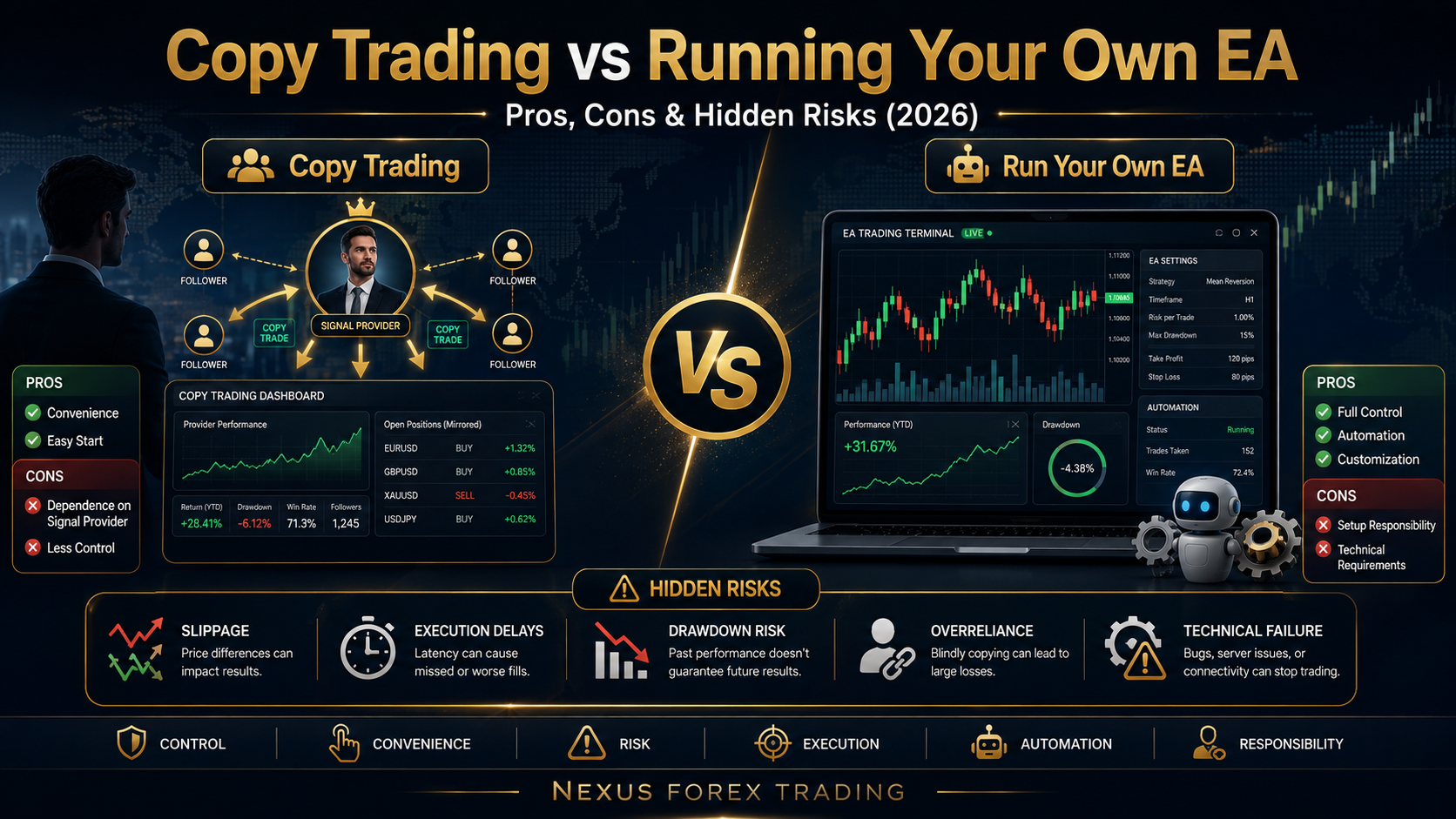
Ask ten forex traders how they automate their trading in 2026, and you'll get two very different answers. Half will point you toward a copy trading platform, where you allocate capital and let a "master trader" mirror their positions into your account in real time. The other half will point you toward an Expert Advisor — a self-contained piece of software running quietly on your own MT4 terminal, following its own rules, on your own account, with no human in the loop at all.
Both approaches have genuinely exploded in popularity, and both are marketed as the "easy" way to get exposure to the forex market without staring at charts all day. But they are structurally very different products, with different risk profiles, different cost structures, and — importantly — different failure modes. If you're trying to decide between the two, the honest answer is: it depends entirely on what you're optimising for. Let's break down exactly what each one is, where each one shines, and the hidden risks that rarely make it into the marketing copy.
What Copy Trading Actually Is
Copy trading is an account-linking arrangement. You browse a leaderboard of "signal providers" or "master traders," choose one (or several) based on their track record, and allocate a portion of your capital to follow them. From that point on, their entries, exits, and position adjustments are mirrored into your account automatically, usually with position sizes scaled proportionally to your account balance relative to theirs.
Popular copy trading ecosystems include broker-run platforms like CopyFX, eToro's social trading network, and MT4/MT5 trade-copier tools that link a master account to unlimited follower accounts. The pitch is simple: you don't need to understand the strategy, backtest anything, or write a single line of code. You're essentially renting someone else's judgement.
What Running Your Own EA Actually Is
An Expert Advisor is a program, written in MQL4 or MQL5, that runs directly inside your own MetaTrader terminal. It follows a fixed, predefined set of rules — entry conditions, exit conditions, position sizing, risk limits — and executes them mechanically on your account, in your name, with your broker. There is no third-party human trader making live decisions in the loop. The "decision-maker" is code, and that code doesn't change its mind, doesn't get emotional, and doesn't have a bad day.
Because the EA runs on your own terminal, you can backtest it against years of historical price data using MetaTrader's built-in Strategy Tester before ever risking real capital, and you retain full control over which broker executes your trades, what leverage you use, and when the EA is switched on or off.
Copy Trading: The Real Advantages
1. Zero learning curve to get started. You don't need to understand technical analysis, position sizing, or MQL code. You pick a trader and allocate capital.
2. Transparency of the source. Reputable copy trading platforms show you a live, verified track record of the exact human trader you're about to follow, including drawdown history and win rate — before you commit a cent.
3. Diversification across styles. Nothing stops you from allocating small amounts to several master traders with different strategies (scalping, swing, news-based) to smooth out your overall equity curve.
Copy Trading: The Hidden Risks Nobody Puts In The Headline
This is where the marketing usually stops, and where a fuller picture starts. Copy trading has several structural risks baked into how it works mechanically, not just risks tied to picking a "bad" trader:
Slippage compounds silently. There is always a small delay between the master trader's execution and the moment your account replicates it. Industry analysis of multi-account copy setups shows slippage in copy trading commonly runs in a meaningful range per trade — enough that a leader's clean scalp can leave followers with visibly less of the move once slippage is accounted for, especially during high-impact news events. Multiply that across hundreds of trades a month, and the gap between the master's published return and your actual return can become substantial.
You are exposed even when the master isn't reckless. If SL/TP levels aren't faithfully copied — something that happens more often than most followers realise, particularly with master traders who deliberately hide stop levels — your account can be left holding an uncovered position during a network hiccup or a broker disconnect, with no safety net in place.
Infrastructure failure is a real category of risk, not an edge case. If the copying software crashes, loses connection, or fails to resynchronise properly after a disconnect, your account can be left in an unintended position, or miss a critical exit signal entirely, through no fault of the strategy itself.
You're trusting a person, not a fixed rule set. Master traders can change their risk appetite overnight, increase leverage after a losing streak trying to "win it back," or simply stop trading altogether. You are, in a very real sense, handing discretionary control of your capital to someone whose future behaviour you cannot fully verify — even if their past behaviour looks clean.
Running Your Own EA: The Real Advantages
1. The rules never drift. An EA follows the exact same logic on trade #1 and trade #10,000. It doesn't get greedy after a win or revenge-trade after a loss. That consistency is precisely why disciplined, rules-based systems tend to produce smoother equity curves over time than any human, however skilled.
2. You can verify the strategy before you risk a cent. MetaTrader's Strategy Tester lets you run an EA against years of historical price data, and MT5 even supports tick-by-tick accurate testing that models slippage and spread realistically — something copy trading simply has no equivalent for, since you're relying entirely on a third party's self-reported history.
3. No master-trader dependency risk. There's no human on the other end who might change strategy, retire, or blow up an account you're mirroring. The code is the code.
4. Full custody and control. Your funds stay in your own broker account, under your own name, at all times. You choose the broker, the leverage, and you can pause or stop the EA instantly whenever you choose.
Running Your Own EA: The Hidden Risks
EAs aren't a free lunch either, and it's worth naming the real risks honestly rather than pretending automation removes all of them:
Backtests can be curve-fitted. A strategy can be over-optimised to historical data until it looks flawless on paper and then underperforms in live, forward-moving markets. This is exactly why live, third-party verified trading history — not just a backtest report — matters so much when evaluating any EA before you buy it.
Grid and martingale-style systems carry real basket risk. Some EAs manage risk through structured position-building rather than a fixed stop loss on every single trade. That's a legitimate design choice used by many systems, but it's one every buyer deserves to understand clearly before switching an EA on — reputable providers will explain exactly how their risk model works rather than glossing over it.
VPS and uptime matter. An EA only trades when it's actually running. If your terminal is on a home PC that goes to sleep or loses internet, the EA can miss trade management at a critical moment — which is why most serious EA traders run on a dedicated VPS for 24/7 uptime.
So Which One Actually Fits You?
If you want your capital tied to a specific human's ongoing discretionary judgement, value the social/community angle of following named traders, and are comfortable with slippage and infrastructure risk as a trade-off for zero setup effort — copy trading can be a reasonable entry point, provided you research the master trader's verified track record thoroughly and never allocate more than you're prepared to lose to a strategy you don't fully control.
If you want a rules-based system that behaves identically every single time, that you can independently verify with real historical and live data before committing capital, and that keeps your funds under your own control at all times — running your own EA on your own MT4 account is the more transparent, more auditable path.
Neither approach eliminates risk. Forex trading always carries risk, whichever automation route you choose. The real differentiator is transparency: does the provider — whether it's a master trader's profile or an EA's Myfxbook page — show you the real, live, unedited numbers, good months and bad, before you commit? If they do, you're in a far better position to make an informed decision. If they don't, that's the biggest hidden risk of all.
Further Reading
- MetaTrader 4 Strategy Tester documentation — how to backtest an EA before going live
- FCA guidance on social and copy trading risk — a regulator's view on what to check before following a signal provider
- Myfxbook — independent, third-party verification for both copy-trading track records and EA performance
Want The Transparency of a Rules-Based EA, Fully Verified?
Nexus Forex Trading runs on your own MT4 account, under your own control, with every result published live on Myfxbook — no discretionary master trader, no black box. See exactly how it trades before you commit a cent.
Join Nexus Forex Trading — Start Your Free Trial →This article is for educational purposes only and does not constitute financial advice. Forex trading, whether via copy trading or automated EAs, carries a significant risk of loss and is not suitable for everyone. Past performance is not a guarantee of future results.