
Forex trading is one of the most popular markets in the world, but it is also one of the most misunderstood. Many new traders hear phrases such as “buy EURUSD,” “trade the London session,” “use leverage,” or “catch the breakout,” but they often enter the market without understanding what is really happening behind the screen.
At its simplest, forex trading means buying one currency while selling another. The goal is to profit from changes in exchange rates. For example, if you believe the euro will strengthen against the US dollar, you may buy EURUSD. If you believe the pound will weaken against the US dollar, you may sell GBPUSD.
The global foreign exchange market is enormous. The Bank for International Settlements reported that global FX trading reached around $7.5 trillion per day in April 2022, making it the largest financial market by turnover. This size attracts banks, institutions, hedge funds, businesses, brokers, and retail traders. But size alone does not make forex easy. In fact, because forex is often traded with leverage, poor risk control can cause losses much faster than beginners expect.
This guide explains the core ideas behind forex trading, gives practical examples, outlines the biggest risks, and shows why many traders now use rules-based automation, such as the Nexus Strength EA for EURUSD and GBPUSD, to bring more discipline into their trading process.
What Is Forex Trading?
Forex, also called FX or foreign exchange, is the market where currencies are exchanged. Unlike a single stock exchange, forex is a decentralised global market. Traders do not buy “a currency” in isolation. They trade currency pairs.
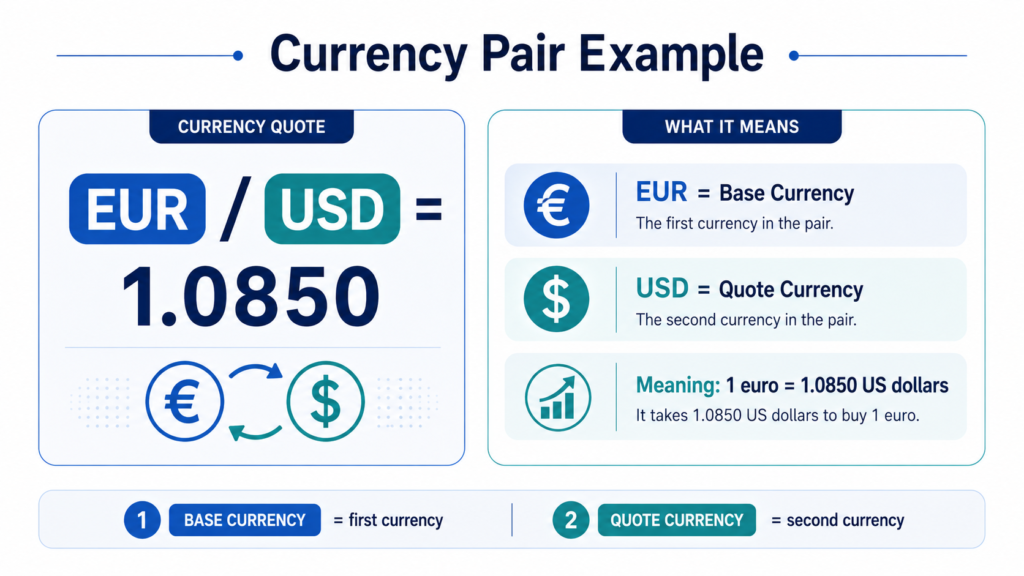
A currency pair shows the value of one currency compared with another. The first currency is called the base currency, and the second is the quote currency. In EURUSD, EUR is the base currency and USD is the quote currency. If EURUSD is trading at 1.1000, it means one euro is worth 1.10 US dollars.
The eToro Academy guide explains that forex trading involves speculating on whether one currency will rise or fall against another, and it highlights common concepts such as currency pairs, bid/ask prices, spreads, and risk.
A simple example:
You believe the euro will strengthen against the US dollar. EURUSD is trading at 1.0800. You buy EURUSD. Later, the price rises to 1.0900. That 100-pip move represents a gain if your position was long.
But if EURUSD falls from 1.0800 to 1.0700, your long position loses value. This is why forex trading is not about guessing direction only. It is about managing position size, risk, stop losses, timing, and market conditions.
What Are Pips, Lots and Spreads?
To trade forex properly, you need to understand three basic terms: pip, lot, and spread.
A pip is the standard unit used to measure movement in most currency pairs. For many major pairs, one pip is usually the fourth decimal place. For example, a move in EURUSD from 1.0800 to 1.0810 is a 10-pip move. Investopedia describes a pip as the smallest price increment commonly used in currency markets.
A lot is the trade size. Common lot sizes include:
| Lot Type | Units of Base Currency | Typical Use |
| Standard lot | 100,000 units | Larger accounts |
| Mini lot | 10,000 units | Smaller active accounts |
| Micro lot | 1,000 units | Beginners and risk-controlled trading |
| Cent account sizing | Broker-dependent | Testing and lower capital exposure |
The spread is the difference between the buy price and sell price. If EURUSD has a bid price of 1.0800 and an ask price of 1.0802, the spread is 2 pips. Lower spreads are especially important for automated strategies, scalping systems, and high-frequency trading approaches because trading costs can quickly add up.
Why Traders Focus on EURUSD and GBPUSD
EURUSD and GBPUSD are two of the most closely watched forex pairs. They are popular because they usually have strong liquidity, tight spreads, and regular movement during the London and New York sessions.
EURUSD is often considered the benchmark forex pair. It reflects the relationship between the eurozone and the United States, two of the world’s largest economic regions. It is heavily influenced by interest rate expectations, inflation data, central bank policy, employment numbers, and global risk sentiment.
GBPUSD, often called “Cable,” can be more volatile than EURUSD. It is influenced by UK economic data, Bank of England policy, US dollar strength, and broader market sentiment. For traders, this can create opportunity, but it also means GBPUSD requires careful risk management.
For beginners, focusing on a small number of major pairs can be better than jumping between dozens of markets. A trader who studies EURUSD and GBPUSD every day will often understand their rhythm, session behaviour, volatility patterns, and common reactions better than someone constantly switching pairs.
How Forex Prices Move
Forex prices move because of supply and demand. If more market participants want to buy euros than sell them, EURUSD may rise. If more traders and institutions want US dollars, EURUSD may fall.
The main drivers include:
- Interest rates
Higher interest rate expectations can support a currency because investors may seek higher yield. - Inflation data
Inflation affects central bank decisions, which can influence currency strength. - Employment data
Strong labour market numbers can shift expectations around future monetary policy. - Central bank speeches
Comments from the Federal Reserve, European Central Bank, or Bank of England can move markets quickly. - Risk sentiment
In uncertain markets, traders may move toward perceived safe-haven currencies such as the US dollar, Japanese yen, or Swiss franc. The eToro guide also notes that some currencies are considered “safe-haven” currencies during unsettled market conditions. - Technical levels
Traders often watch support, resistance, trend lines, moving averages, previous highs, and previous lows. BabyPips explains support as a price area where a downtrend may pause due to buying interest.
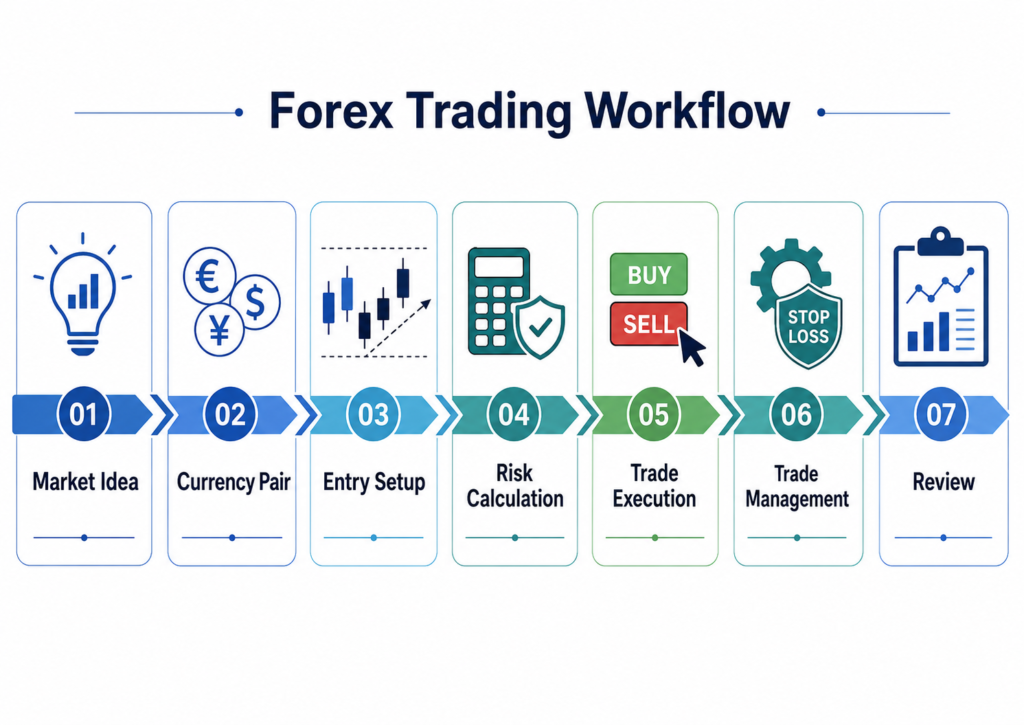
Beginner Forex Trade Example
Let’s say EURUSD is trading near 1.0850. You believe price may rise because it has bounced from support, momentum is turning positive, and the US dollar is weakening.
A basic trade plan could look like this:
| Trade Element | Example |
| Pair | EURUSD |
| Direction | Buy |
| Entry | 1.0850 |
| Stop loss | 1.0800 |
| Take profit | 1.0950 |
| Risk | 50 pips |
| Reward | 100 pips |
| Risk-to-reward | 1:2 |
This does not mean the trade will win. It simply means the trader has a defined plan. The most dangerous beginner mistake is entering a trade with no stop loss, no position size calculation, and no exit logic.
A disciplined trader asks:
“How much can I lose if I am wrong?”
A reckless trader asks:
“How much can I make if I am right?”
That difference matters.
The Real Risk: Leverage
Leverage allows traders to control a larger position with a smaller deposit. This is one reason forex is attractive, but it is also one of the biggest reasons beginners lose money.
If leverage is used badly, a small market movement can create a large account loss. The CFTC warns that retail off-exchange forex trading can be extremely risky, especially when traders do not understand how profits are generated or how leverage works.
For example, imagine two traders:
| Trader | Account Balance | Risk Per Trade | Stop Loss | Result of Losing Trade |
| Trader A | $1,000 | 1% | 50 pips | -$10 |
| Trader B | $1,000 | 10% | 50 pips | -$100 |
Both traders took the same market direction. Both were wrong. But Trader A can survive many losing trades. Trader B may destroy confidence and capital after only a few bad decisions.
Good forex trading is not about avoiding losses completely. Losses are part of the business. The goal is to keep losses controlled, repeatable, and small enough that your account can survive long-term.
Why Most Beginners Struggle
Most new forex traders do not fail because they cannot understand a chart. They fail because they lack structure.
Common beginner mistakes include:
- Trading too many pairs at once
- Increasing lot size after a loss
- Moving stop losses further away
- Overtrading during news
- Chasing candles after a big move
- Ignoring spreads and slippage
- Using leverage without understanding risk
- Switching strategy after every losing day
- Treating forex as quick money instead of a skill-based market
This is why a trading plan is essential. A good plan defines what to trade, when to trade, how much to risk, where to enter, where to exit, and when to stay out.
Technical Analysis vs Fundamental Analysis
Forex traders usually rely on two major forms of analysis: technical and fundamental.
Technical analysis uses charts, price action, indicators, support, resistance, trend structure, and momentum. A technical trader may use RSI, moving averages, candlestick patterns, or breakouts to identify opportunities.
Fundamental analysis studies economic forces such as interest rates, inflation, employment, GDP, central bank policy, and geopolitical events.
The best traders often understand both. For example, a EURUSD technical setup may look attractive, but if a major US inflation report is due in 10 minutes, the risk may be too high. This is where economic calendars become useful.
Where Automated Forex Trading Fits In
Automated forex trading uses software to follow predefined rules. In MetaTrader 4, this software is called an Expert Advisor, or EA.
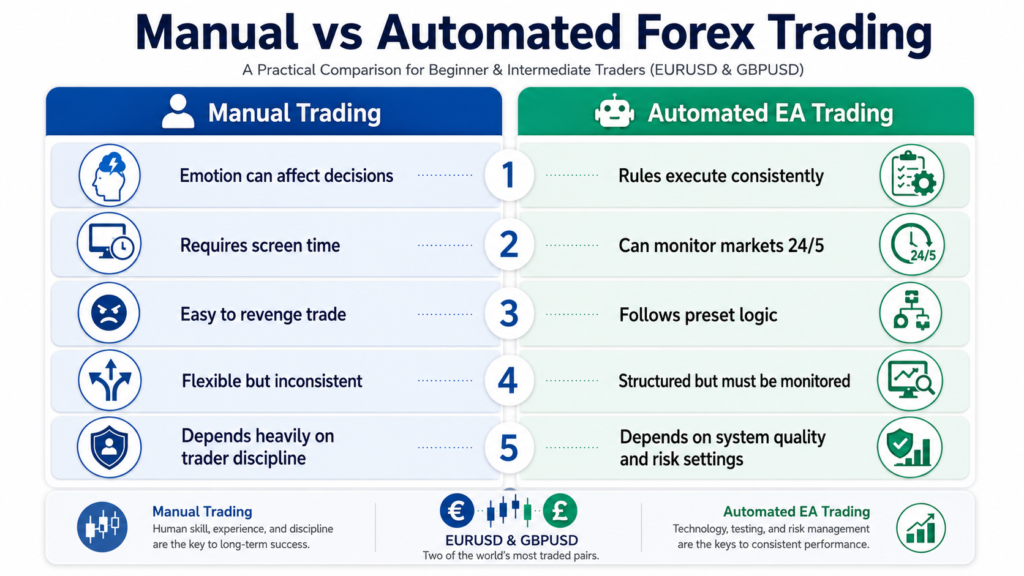
A good EA does not remove risk. It removes emotional inconsistency. It can follow rules without hesitation, revenge trading, fear, greed, or boredom.
This is where Nexus Forex Trading focuses its approach. The Nexus Strength EA is a rules-based MT4 Expert Advisor designed for EURUSD and GBPUSD. According to the Nexus product page, it uses an RSI-driven trading system with AI-assisted optimisation, risk-first equity protection, disciplined position sizing, max-trade limits, and a focus on repeatable execution rather than hype.
That matters because many traders know what they should do but fail to do it consistently. They exit winners too early, hold losers too long, increase lot size emotionally, or abandon their plan after a few trades. A properly configured EA can help create a more systematic process.
However, no EA should be treated as a magic money machine. Market conditions change. Spreads change. Broker execution varies. Slippage happens. News events can cause sharp movement. That is why testing, broker selection, risk settings, and ongoing monitoring are essential.
How to Build a Safer Forex Trading Foundation
Before trading live, beginners should build a foundation in five areas.
1. Learn the basics first
Understand pairs, pips, spreads, lots, leverage, margin, stop losses, and take profits. The eToro Academy forex guide is a useful starting point for beginner concepts such as currency pairs, quotes, bid/ask spreads, and basic risk.
2. Start with major pairs
Pairs such as EURUSD and GBPUSD usually offer better liquidity than exotic pairs. This can mean tighter spreads and cleaner execution, although volatility still varies by market session and news events.
3. Risk small
Many serious traders risk only a small percentage per trade. Even if you use an EA, risk settings should be selected carefully. Higher risk may look attractive during winning periods, but it can create uncomfortable drawdowns during difficult market conditions.
4. Demo test before live trading
A demo account helps you understand behaviour without risking real money. It will not fully replicate live slippage or psychology, but it is still a necessary first step.
5. Track results
Every serious trader should review performance. Track win rate, average win, average loss, drawdown, trade frequency, time of day, and pair performance. Without data, traders often make emotional decisions based on the last few trades.
Good Forex Resources for Continued Learning
Here are useful resources to continue learning:
- eToro Academy Forex Guide — beginner explanation of currency trading, pairs, spreads, and risks.
- Bank for International Settlements FX Survey — official data on global forex market turnover.
- BabyPips School of Pipsology — beginner-friendly education on forex basics, support and resistance, and trading concepts.
- CFTC Forex Fraud Warnings — important risk education for retail traders.
- Nexus Forex Trading EURUSD & GBPUSD EA Page — for traders who want a rules-based MT4 EA approach with risk-first automation.
Final Thoughts: Forex Trading Rewards Discipline, Not Guesswork
Forex trading can be exciting, but it should never be approached casually. The market is liquid, global, and active 24 hours a day during the trading week, but that does not mean every moment is a good time to trade. The traders who last are usually the ones who respect risk, follow a plan, track performance, and avoid emotional decision-making.
For beginners, the goal should not be to trade everything. Start by understanding the basics. Learn how currency pairs move. Focus on clean major pairs such as EURUSD and GBPUSD. Use small risk. Study price behaviour. Review economic news. Test before going live.
And once you understand the foundations, automation can become a powerful tool. A rules-based EA can help remove emotional mistakes, execute consistently, and apply a structured strategy around the clock. But it must still be used responsibly, with realistic expectations and proper risk control.
Converting CTA
Ready to Trade EURUSD and GBPUSD with a Rules-Based MT4 Forex EA?
If you want to move beyond guesswork and start using a structured, risk-first approach to automated forex trading, Nexus Forex Trading gives you access to professionally built EURUSD and GBPUSD MT4 EA solutions designed around disciplined execution, preset risk profiles, and transparent trading logic.
Join Nexus Forex Trading today and get an extra 50% discount when you use code:
nexus50fx
Join now: https://nexusforextrading.com/eurusd-gbpusd-ea-bot/