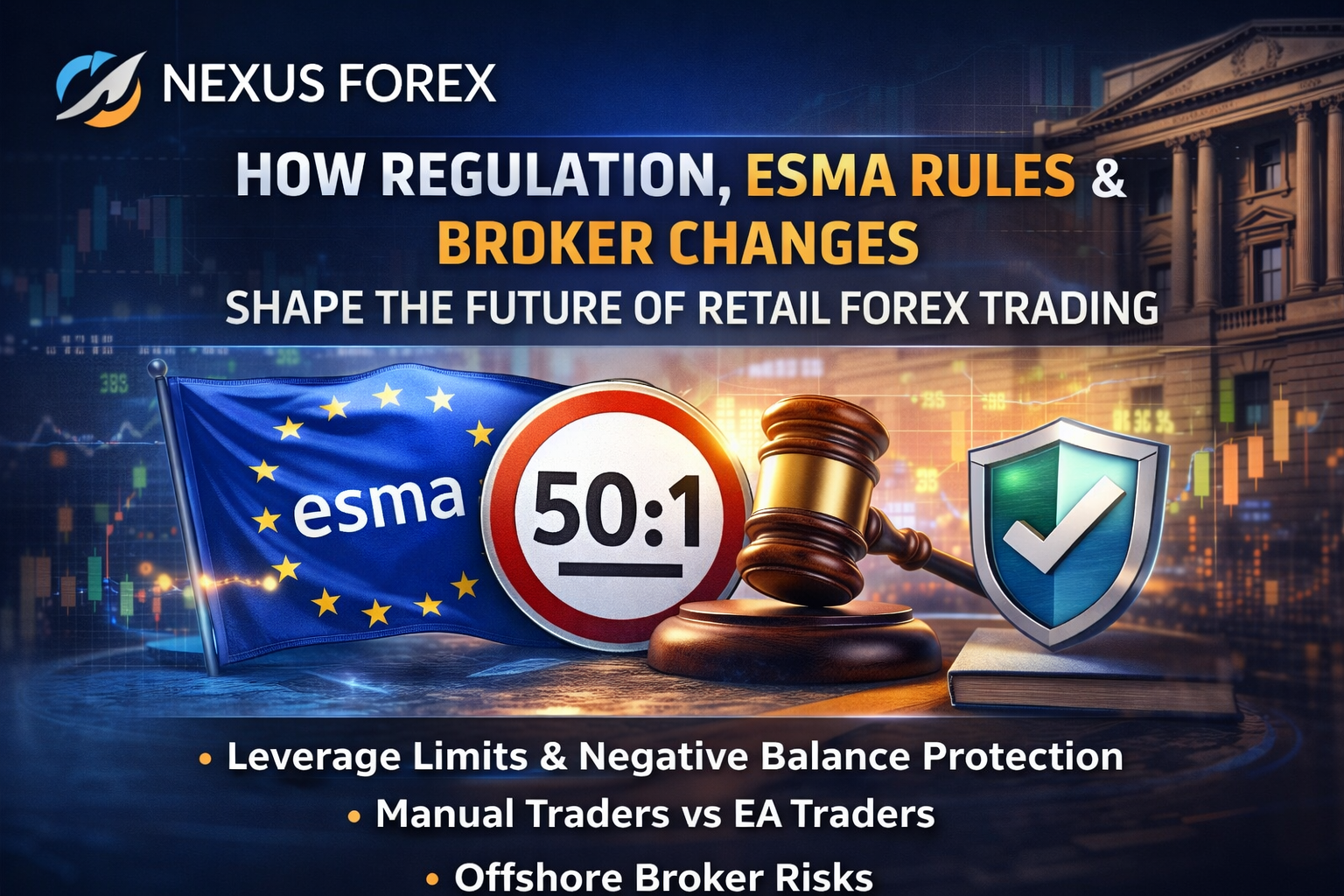
Retail forex has entered a new era where regulation is no longer a background detail—it’s a strategy variable. If you’re trading spot FX via CFD-style products (including rolling spot FX CFDs), ESMA rules retail forex trading standards—plus similar UK, Australian, and US rules—have changed how much leverage you can access, how quickly positions can be closed out, and how brokers market (and price) their products.
That shift affects everyone, but not equally. EA traders feel it through margin constraints, execution rules, and strategy viability. Manual traders feel it through tighter risk controls, reduced “room” for recovery, and higher sensitivity to costs like spreads and overnight funding. And whenever leverage gets capped onshore, the temptation rises to “solve” it with offshore brokers—often by giving up protections that exist for a reason.
This post breaks down what’s changing, why it matters, and how to adapt safely.
1) The Evolution of Retail Forex Regulation: Why the Rules Tightened
Across Europe and the UK, regulators have repeatedly pointed to a consistent pattern: most retail clients lose money on leveraged CFD-style products, and the combination of high leverage + volatile markets can turn small price moves into account-ending losses. In Ireland, the Central Bank described major investor protection concerns tied to complexity, lack of transparency, and “excessive leverage,” noting that very high leverage levels (e.g., 400:1) were observed prior to ESMA’s intervention, alongside persistent retail losses.
Globally, different regulators landed on similar conclusions:
- UK FCA made ESMA-style restrictions permanent for retail CFDs.
- ASIC (Australia) implemented leverage caps and stronger CFD protections starting March 2021.
- US retail forex leverage is limited (commonly cited as 50:1 on majors and 20:1 on others under CFTC rules).
The direction of travel is clear: more guardrails, fewer “high-octane” features, and tighter scrutiny of marketing and client categorisation.
2) What ESMA Rules Actually Do (and Why They Matter to Forex Traders)
ESMA’s intervention framework for CFDs (including rolling spot FX CFDs) focuses on five core protections: leverage limits, margin close-out protection, negative balance protection, incentive restrictions, and standardised risk warnings.
2.1 Leverage limits: the tiered caps that reshape position sizing
ESMA framed leverage limits through initial margin requirements. In plain English: the higher the required margin, the lower the max leverage.
From ESMA’s details:
- Major FX pairs: 3.33% initial margin (≈ 30:1 leverage)
- Non-major FX pairs + gold + major indices: 5% margin (≈ 20:1)
- Other commodities + non-major indices: 10% margin (≈ 10:1)
- Shares/other: 20% margin (≈ 5:1)
- Crypto CFDs: 50% margin (≈ 2:1)
Why it matters: if your strategy’s edge relies on large position sizes or recovering drawdowns via leverage, the math changes immediately.
2.2 Margin close-out at a standard level (the “stop-out” reality)
ESMA’s framework includes a margin close-out rule on a per-account basis: brokers must close positions when the account’s funds plus unrealised P/L falls below 50% of the total initial margin required for open positions.
For traders, this means:
- Less “wiggle room” for floating drawdowns
- Grid/martingale approaches are far more likely to be forcibly closed
- You must plan for buffer margin, not just “minimum margin”
2.3 Negative Balance Protection (NBP): why it exists
Negative balance protection limits a retail trader’s total liability to the funds in their CFD trading account—so an extreme gap event can’t create a debt beyond your deposit (within the scope of the rule).
This isn’t theoretical. During a volatile period in March–April 2020, ASIC noted large retail losses and many accounts going negative—part of the reason regulators tightened protections.
2.4 No “incentives” and mandatory risk warnings
ESMA-style measures restrict incentives (like bonuses) that can distract from product risk and require a standardised risk warning that includes the percentage of retail accounts that lose money.
Practical takeaway: if a broker’s marketing looks like it’s designed to make you trade more rather than trade better, regulators increasingly see that as a red flag.
3) Broker Changes: The Rules Aren’t Just “Leverage Caps” Anymore
The big shift in 2025–2026 is that regulators are focusing not only on product rules, but also on how brokers behave.
3.1 Pressure to opt into “professional” status (and why it’s dangerous)
In October 2025, the UK FCA publicly warned investors not to give up retail protections by claiming professional status under pressure—flagging that this can expose clients to losing more than they can afford and even change how client money is protected.
The FCA also warned about firms redirecting retail clients to third-country providers without equivalent protections and about “finfluencer” promotion of offshore firms.
3.2 Pricing scrutiny: spreads are only part of the cost
Regulators are increasingly scrutinising whether CFD providers deliver “fair value,” including how they disclose and justify overnight funding charges. Reuters reported the FCA warning firms after a review found issues such as funding charges applied without clear justification and disclosure.
What that means for traders:
- Holding leveraged positions overnight can cost more than many strategies assume
- Backtests that ignore funding/spread reality can look profitable but fail live
4) EA Traders vs Manual Traders: How Regulation Hits Differently
EA (Automated) Traders: what breaks first
EAs often depend on one or more of these:
- High leverage to amplify small edges (scalping, high frequency)
- Recovery logic (grid/martingale) that assumes the broker won’t close you out early
- Tight execution assumptions (spread + slippage stability)
Under ESMA-style rules, the combination of lower leverage + 50% close-out makes leverage-dependent recovery systems much more fragile.
Manual Traders: where the pressure shows up
Manual traders are less likely to “break” due to code assumptions, but they often feel:
- The need to trade smaller (which can reduce emotional “reward”)
- More frequent stop-outs if they overtrade volatile events
- Higher sensitivity to costs, especially if holding overnight
5) Practical Adaptation Strategies (that don’t rely on offshore risk)
5.1 Universal upgrades: work with the rules, not against them
- Reduce leverage dependency: treat 30:1 as a ceiling, not a target.
- Rebuild position sizing around risk per trade (e.g., 0.25–1.0%), not lot size.
- Trade instruments that match your leverage tier: major FX pairs tend to have the highest allowable leverage under ESMA-style rules.
- Margin budgeting: keep a healthy free-margin buffer so the 50% close-out doesn’t become your hidden “stop-loss.”
- Plan around volatility: major data releases can gap; don’t assume smooth fills.
5.2 EA-specific: make your algo “regulation-resistant”
- Re-optimise with realistic constraints: cap leverage at 30:1 (or lower), model wider spreads and slippage.
- Hard stop logic > recovery logic: replace martingale/grid recovery with maximum loss limits, time stops, and volatility filters.
- Add a news filter: avoid trading around high-impact events where spreads widen and gaps happen.
- Lower trade frequency: fewer, higher-quality setups can outperform “spray and pray” under tighter cost controls.
5.3 Manual-specific: trade the calendar, not the hype
- If you trade macro news, consider waiting for post-release confirmation rather than trying to catch the first spike.
- For swing trading, audit the impact of overnight funding and reduce holds where the cost-to-edge ratio is poor.
- Keep risk consistent: volatility weeks often trigger revenge trading—your rules should tighten, not loosen.
Educational note: This is general information, not personal financial advice. Trading leveraged products involves significant risk.
6) Why “Offshore Fixes” Are Often a Trap (and how to check a broker properly)
When onshore leverage drops, offshore ads get louder. But the trade-off can be brutal:
- Weaker (or no) negative balance protection
- Poorer dispute resolution options
- Harder-to-enforce client money safeguards
- Higher fraud and withdrawal-risk exposure
The FCA explicitly warned that some investors are being pushed toward professional categorisation or redirected offshore, losing key protections.
Do this instead: verify regulation using official registers
Use regulator tools to confirm authorisation and permissions:
- FCA “How to check” guidance + the Financial Services Register (UK).
- ESMA investor guidance on checking whether a firm is regulated (EU/EEA).
- Central Bank of Ireland registers (Ireland).
- ASIC register search (Australia).
If a broker can’t be verified quickly in the relevant register, treat that as a serious warning sign.
The Bottom Line: Protection vs Flexibility—and the Future of Retail FX
Regulation is pushing retail forex toward a more sustainable model: less leverage, more transparency, and stronger consumer protections. The cost is flexibility; the benefit is survivability. The traders who succeed in 2026 and beyond will be the ones who:
- build strategies that don’t require extreme leverage,
- treat costs and margin mechanics as first-class inputs,
- and choose properly regulated venues they can verify.
Join Nexus Forex Trading: Stay Ahead of Regulation-Driven Market Shifts
Regulation changes how markets behave—especially around volatility, liquidity, and broker execution. Nexus Forex Trading helps you stay informed with education and market context designed for real traders navigating modern constraints.
If you want a cleaner, safer approach to trading in today’s regulated environment, join Nexus Forex Trading and build a strategy that works with the rules—not against them.