There’s a hard truth every automated trader eventually learns:
A profitable EA without risk controls is still a losing system.
Why? Because automation removes hesitation. Your Expert Advisor can place trades 24/7, in every market condition—during thin liquidity, widening spreads, news spikes, and choppy ranges. If your risk parameters are even slightly off, the EA won’t “feel” fear or slow down. It will simply execute… until your account is damaged.
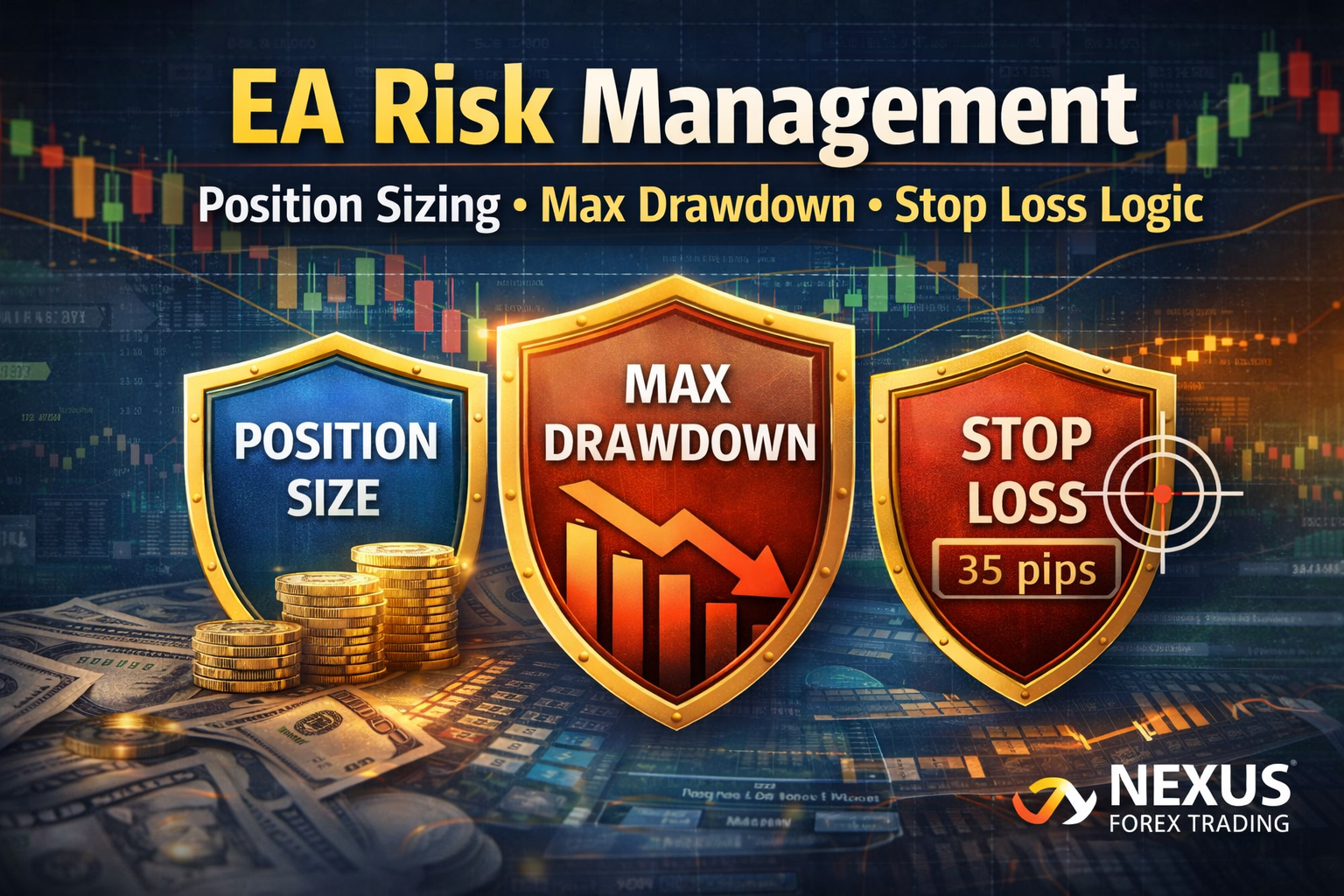
This guide gives you three practical, implementable frameworks that protect capital and keep an EA tradeable long-term:
- Position sizing strategies (how much you trade)
- Maximum drawdown thresholds (when to reduce risk or stop)
- Stop loss logic (where you exit when wrong)
If you get these three right, everything else becomes easier—optimization, scaling, and consistency.
Why EA Risk Management Is Different From Manual Trading
Manual traders can choose not to trade. They can hesitate. They can reduce size after a losing streak “because it feels right.”
EAs don’t do that unless you program it.
So, EA risk management must be:
- Rule-based
- Predefined
- Failsafe by design
- Measured at the account level (not just per trade)
That’s why the three controls in this post matter more than your entry signal.
1) Position Sizing for Expert Advisors (The “How Much” Framework)
Position sizing is the fastest way to change your results—good or bad.
In automated forex trading, the goal is simple:
Keep risk consistent even when stop loss size or volatility changes.
The baseline formula every EA trader should know
A common risk-based position sizing formula is:
Lot Size = (Account Balance × Risk %) ÷ (Stop Loss in pips × Pip Value)
This is powerful because it ties your trade size directly to:
- what you’re willing to lose (risk %)
- how far your invalidation point is (stop loss)
If your EA can’t calculate this automatically, you can still build it into your rules (or use a calculator like Myfxbook’s).
Position sizing methods that work well for EAs
A) Fixed lot sizing (simple, but dangerous when scaling)
What it is: Always trade the same lot size (e.g., 0.10 lots).
When it’s ok: Small accounts, micro-lot testing, or strict exposure caps.
The problem: As equity changes, your risk changes. A fixed 0.10 lot becomes bigger risk during drawdowns and smaller risk after gains.
EA rule upgrade: If you use fixed lots, pair it with a hard drawdown circuit breaker (Section 2).
B) Fixed fractional sizing (best “default” for most automated traders)
What it is: Risk a fixed percentage per trade (e.g., 0.25%–1.0%).
Why it’s great for EAs: It automatically scales down during drawdowns and scales up during growth.
Practical EA framework (good starting ranges):
- Conservative: 0.25%–0.50% risk per trade
- Moderate: 0.50%–1.00%
- Aggressive (not recommended for most): 1.00%–2.00%
EA-specific safety rule: Cap total open risk across positions:
- Example: “Max open risk across all trades = 2%”
- If EA wants to open a new trade but would exceed 2% open risk, it skips.
C) Volatility-based sizing (ATR-aware position sizing)
What it is: Your stop distance and size adapt to volatility using ATR (Average True Range). ATR measures market volatility and is widely used to set stop losses and manage risk.
EA framework:
- Compute ATR on your operating timeframe (e.g., H1, H4)
- Set stop loss = ATR × multiplier (like 1.5× or 2.0×)
- Calculate lot size using the risk formula
Why it helps EAs: In higher volatility, stops widen and lots shrink automatically—often preventing “normal volatility” from becoming “stop-out volatility.”
D) Kelly Criterion (advanced—use fractional Kelly only)
The Kelly Criterion estimates an “optimal” risk fraction based on win rate and payoff. It’s mathematically elegant, but too aggressive for most traders if used at full strength.
EA-safe version: Quarter-Kelly or Half-Kelly, with strict caps:
- Never exceed 1% per trade unless you have long verified data
- Combine with drawdown circuit breakers
Bottom line: Kelly can be useful for systematic traders, but most EA traders do best with fixed fractional + volatility-aware stops.
A quick example (so you can apply this today)
- Equity: $10,000
- Risk per trade: 0.5% → $50
- Stop loss: 25 pips
- Pip value: ~$10 per pip per 1.00 lot (EUR/USD)
Lot size ≈ $50 / (25 × $10) = 0.20 lots
(Your pip value varies by pair, lot size, and account currency—use a calculator to be precise.)
2) Maximum Drawdown Thresholds (The “When to Stop” Circuit Breakers)
Maximum drawdown (MDD) is a key risk metric that measures the worst peak-to-trough decline over a period.
For EAs, drawdown isn’t just a statistic. It’s your survival boundary.
The EA drawdown rule most traders skip (and regret later)
Every EA should have an account-level kill switch—a rule that pauses or stops trading when drawdown hits a predefined limit.
Why?
Because drawdowns can accelerate during:
- regime changes (trend → chop)
- spread widening / slippage
- correlated exposure across pairs
- news volatility
Build a 3-level circuit breaker (simple and effective)
Here’s a clean framework you can implement in most EAs or trade managers:
Level 1: Warning threshold (reduce risk)
- Trigger: -5% from equity peak
- Action: reduce risk by 50% (or switch to conservative preset)
Level 2: Pause threshold (cool-down)
- Trigger: -8% from equity peak
- Action: pause new entries for 24–72 hours
- Optional: allow only trade management (trail stops, exit logic)
Level 3: Hard stop threshold (stop trading)
- Trigger: -10% from equity peak
- Action: stop EA completely and review market conditions/settings
These numbers are examples—not universal truth. But the structure is what matters: reduce → pause → stop.
Add daily/weekly loss limits (especially if prop-firm oriented)
Many prop environments use strict drawdown rules, so even if you’re not in one, these controls are smart:
- Daily loss limit: 1%–2%
- Weekly loss limit: 3%–5%
Even one day of abnormal conditions shouldn’t be allowed to define your month.
3) Stop Loss Logic for EAs (The “Where You’re Wrong” System)
Stop losses are not optional in automation. They’re how you quantify invalidation and convert uncertainty into a controlled loss.
Also, on MetaTrader platforms, stop loss/take profit levels are standard protective order levels—your EA can set them when opening or modifying positions.
Stop loss styles that work well in automated forex trading
A) Fixed pip stop loss (simple, consistent, but context-blind)
Best for: scalping systems with stable volatility assumptions
Problem: a 20-pip stop means something totally different in quiet vs volatile markets.
EA rule upgrade: Add a volatility filter (trade only when ATR is within a healthy band).
B) ATR-based stop loss (volatility-aware default)
ATR is widely used to set stops that adapt to market movement.
Framework:
- SL = ATR(14) × 1.5 (example)
- For trend systems: often 2.0×–3.0×
- For mean reversion: often 1.0×–2.0×
This prevents “normal volatility” from repeatedly clipping your EA.
C) Structure-based stop loss (support/resistance logic)
What it is: Stop goes beyond a technical level (swing high/low, prior structure).
Best for: higher-timeframe EAs and trend-following logic.
EA caveat: You must define structure precisely:
- “Swing low = lowest low of last N candles”
- “Stop buffer = spread + X pips”
D) Trailing stops and break-even rules (profit protection, not entry protection)
Trailing stops are great—but only if they match your strategy type.
EA-safe approach:
- Move stop to break-even only after a meaningful threshold (e.g., +1R)
- Trail based on ATR or structure, not tiny pip increments (reduces whipsaw exits)
The hidden EA stop loss killers (don’t ignore these)
- Spread and stop-level constraints: brokers enforce minimum distances (“stop level”) from price; EAs must handle this cleanly.
- Slippage during volatility: your “planned” stop can fill worse than expected.
- Stop loss too tight for the timeframe: a great way to create a system that looks active but goes nowhere.
How Position Size, Drawdown Limits, and Stop Loss Work Together
Think of the “EA risk triangle” like this:
- Stop loss logic defines how much the market must move to prove you wrong
- Position sizing converts that stop distance into a controlled dollar risk
- Drawdown thresholds protect the account when the strategy hits a bad regime
If you don’t define stop loss properly, your position sizing becomes guesswork.
If you size correctly but don’t cap drawdown, one bad streak can still end you.
If you cap drawdown but size too big, you’ll hit the cap constantly and never scale.
Common EA Risk Management Mistakes (and how to fix them)
Mistake #1: “My EA has a high win rate, so I can increase lots.”
Fix: win rate alone is meaningless without average win/loss, variance, and drawdown behavior.
Mistake #2: No max open risk cap
Fix: cap total open risk (e.g., 2%–3% total at once).
Mistake #3: Using martingale/grid without hard stop controls
Fix: if you’re averaging down, you must have equity limits and maximum exposure rules.
Mistake #4: Stops based on hope, not structure/volatility
Fix: choose one stop method and make it systematic (ATR or structure are best starting points).
Mistake #5: No “kill switch”
Fix: implement the 3-level circuit breaker (reduce → pause → stop).
Practical “Start Here” EA Risk Template (Copy/Paste Rules)
If you want a sensible starting point:
- Risk per trade: 0.5%
- Max open risk: 2%
- Stop loss: ATR(14) × 1.5
- Break-even: after +1R
- Drawdown circuit breaker:
- -5% → reduce risk 50%
- -8% → pause entries 48 hours
- -10% → stop EA + review
This isn’t magic—it’s simply a survivable framework.
Join Nexus Forex Trading (If You Want Risk-Controlled Automation That’s Built to Last)
If you’re serious about automated trading, you don’t need another “secret strategy.”
You need:
- risk presets that match your account size and goals,
- clear, repeatable rules (not vague settings),
- and a community that focuses on consistency, execution, and protection.
Inside Nexus Forex Trading, you’ll get:
- practical EA setup guidance (MT4/MT5, broker considerations, VPS best practices),
- risk-managed approaches built around sustainability,
- and ongoing education so you understand why settings work—not just what to copy.
If you want to trade automation with discipline, not hope—join Nexus Forex Trading and build your system the right way.