Currency pairs are the foundation of forex trading. Every forex trade involves one currency being bought and another currency being sold at the same time. That is why forex is always quoted in pairs, such as EURUSD, GBPUSD, USDJPY, or EURGBP.
For beginners, the concept can look confusing at first. Why does buying EURUSD mean buying euros and selling US dollars? Why is GBPUSD called “Cable”? Why do some pairs have tighter spreads while others are more expensive to trade? And why do experienced traders often focus on a few major pairs instead of trading everything available on a platform?
This guide explains how currency pairs work, the difference between major, minor, exotic, commodity, and cross pairs, and why pair selection matters for risk management, trading costs, and long-term consistency.
The forex market is the largest financial market in the world. The latest BIS Triennial Survey reported that over-the-counter FX turnover reached approximately $9.6 trillion per day in April 2025, up from $7.5 trillion three years earlier. The same BIS release also shows the US dollar remained on one side of 89.2% of all FX trades, highlighting why USD-based pairs dominate global forex activity.
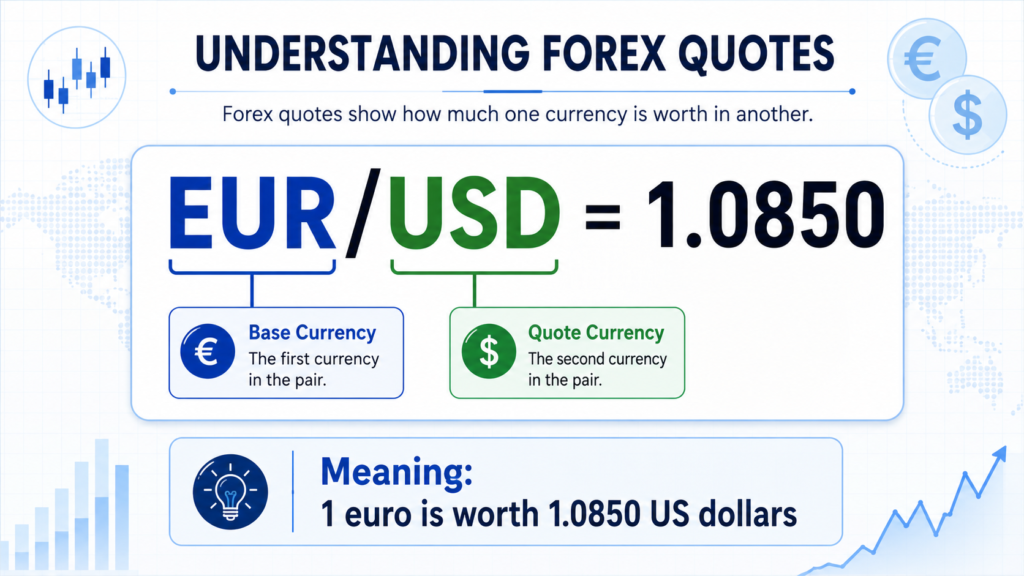
What Is a Currency Pair?
A currency pair is a financial instrument made up of two currencies. The first currency is called the base currency, and the second is called the quote currency. eToro’s Academy explains that a currency pair allows traders to take a view on how the relative value of two currencies will change over time. In EURUSD, EUR is the base currency and USD is the quote currency.
For example:
| Currency Pair | Base Currency | Quote Currency | Meaning |
| EURUSD | Euro | US dollar | Value of 1 euro in US dollars |
| GBPUSD | British pound | US dollar | Value of 1 pound in US dollars |
| USDJPY | US dollar | Japanese yen | Value of 1 US dollar in Japanese yen |
| EURGBP | Euro | British pound | Value of 1 euro in British pounds |
When you buy a currency pair, you are buying the base currency and selling the quote currency. When you sell a currency pair, you are selling the base currency and buying the quote currency.
Example:
If you buy GBPUSD, you are buying British pounds and selling US dollars. If GBPUSD rises, your trade moves into profit. If GBPUSD falls, your trade moves into loss. eToro gives the same GBPUSD example, explaining that a buy trade means going long GBP and short USD, while a sell trade means going short GBP and long USD.
Why Currency Pair Selection Matters
Not all forex pairs behave the same way. Some pairs are highly liquid, have tight spreads, and move smoothly during active sessions. Others are volatile, expensive to trade, and more vulnerable to sudden price gaps.
Choosing the right pair affects:
- Spread costs
- Slippage
- Trade frequency
- Volatility
- Risk exposure
- Strategy performance
- EA performance
- Broker execution quality
For example, a strategy that works well on EURUSD may not automatically work on GBPJPY or USDZAR. EURUSD often has deep liquidity and tight spreads, while many exotic pairs can have wider spreads and sharper price spikes.
This is especially important for automated forex trading. An Expert Advisor may depend on predictable spread conditions, stable execution, and repeatable market behaviour. That is one reason Nexus Forex Trading focuses its MT4 EA products on EURUSD and GBPUSD, two of the most actively watched forex pairs, rather than trying to trade every market at once.
Major Currency Pairs
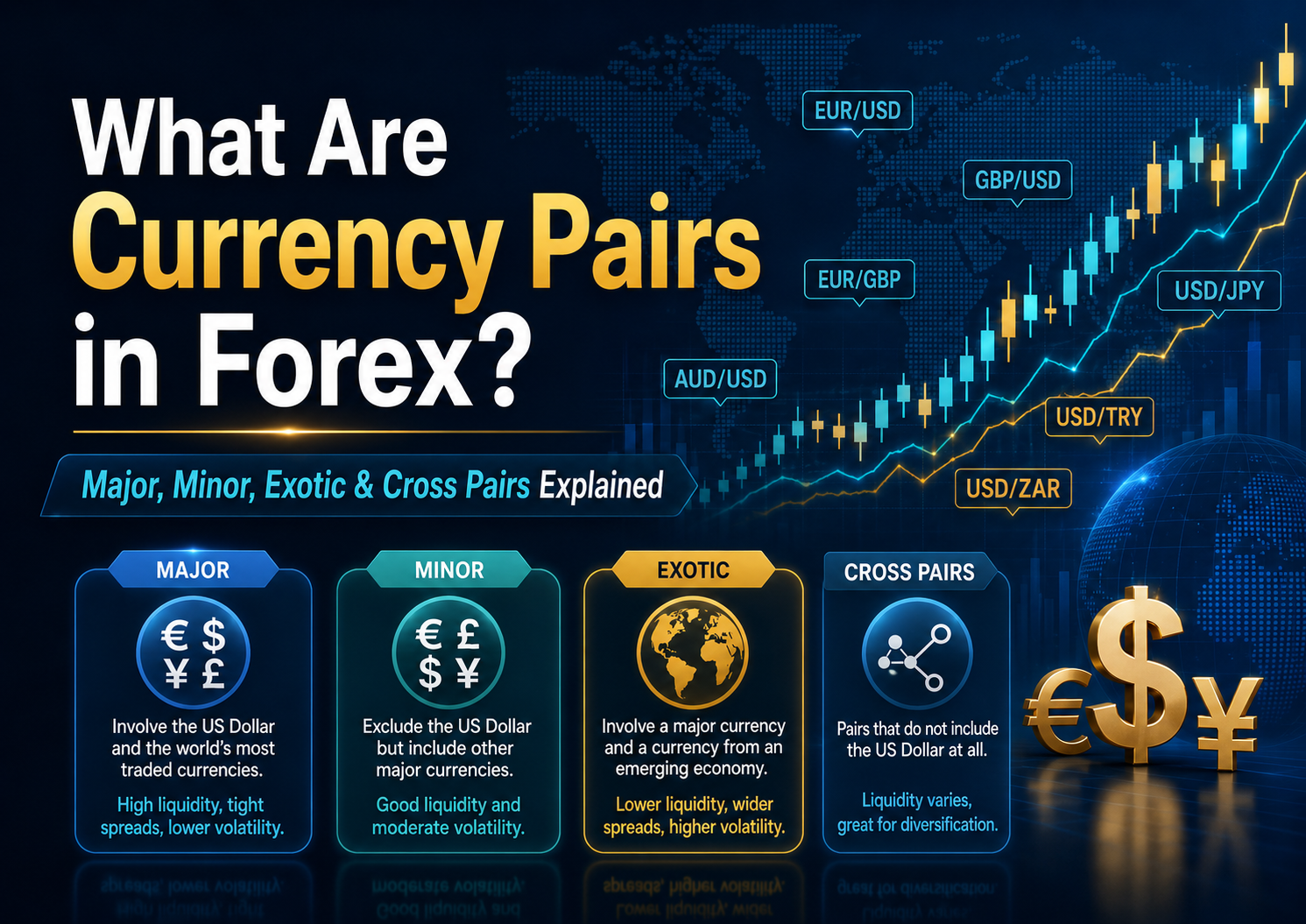
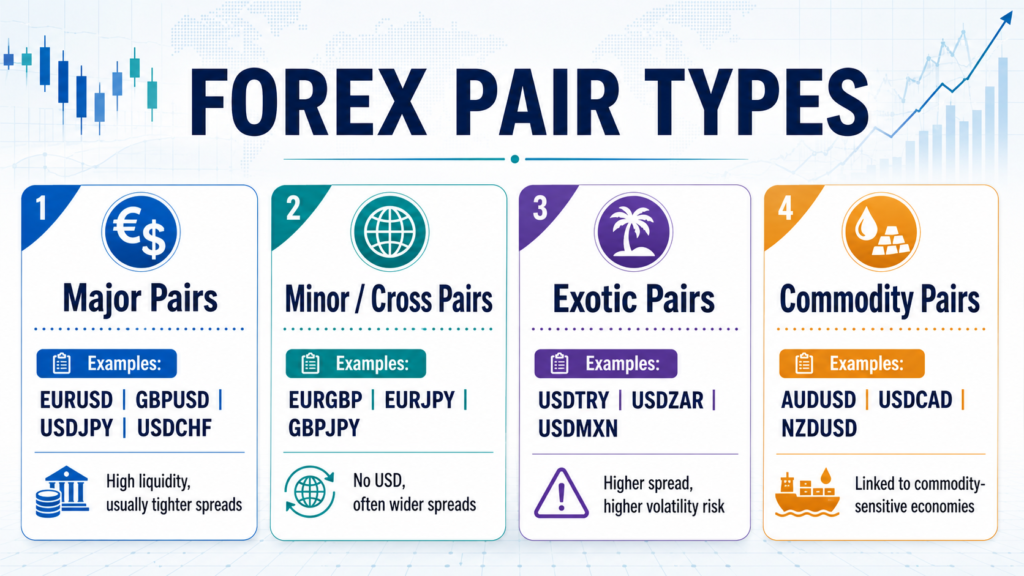
Major currency pairs are the most actively traded forex pairs. They typically include the US dollar and one other major global currency. eToro lists EURUSD, USDJPY, GBPUSD, and USDCHF among the major currency pairs, noting that major pairs are ranked this way because of their high trading volumes and historical importance.
Common major pairs include:
| Pair | Currencies | Common Nickname |
| EURUSD | Euro / US dollar | Fiber |
| GBPUSD | British pound / US dollar | Cable |
| USDJPY | US dollar / Japanese yen | Ninja |
| USDCHF | US dollar / Swiss franc | Swissie |
| AUDUSD | Australian dollar / US dollar | Aussie |
| USDCAD | US dollar / Canadian dollar | Loonie |
| NZDUSD | New Zealand dollar / US dollar | Kiwi |
Major pairs are popular because they often offer stronger liquidity, tighter spreads, and more available market analysis. BabyPips also explains that major pairs include the US dollar and are among the most frequently traded currency pairs.
For beginner traders, major pairs are usually a sensible starting point because there is more educational content, more market commentary, and generally better trading conditions compared with many exotic markets.
Why EURUSD Is So Popular
EURUSD is the most recognised forex pair in the world. It represents the relationship between the eurozone and the United States. Because both economies are major global players, EURUSD attracts banks, hedge funds, institutions, businesses, and retail traders.
EURUSD is heavily influenced by:
- Federal Reserve interest rate expectations
- European Central Bank policy
- US inflation data
- Eurozone inflation data
- US employment data
- Global risk sentiment
- Treasury yields
- Dollar strength or weakness
eToro’s currency pair lesson states that EURUSD makes up approximately a quarter of the total forex market, based on its referenced market-share estimates.
For traders, EURUSD is attractive because it often has tight spreads, high liquidity, and frequent technical setups. For automated systems, these conditions can be especially useful because trading costs matter. A strategy that enters multiple trades per week can be heavily affected by spread and slippage over time.
Why GBPUSD Matters
GBPUSD, commonly known as Cable, is another major pair with strong trading interest. It represents the British pound against the US dollar. GBPUSD can be more volatile than EURUSD, which can create opportunity but also increase risk.
GBPUSD is influenced by:
- Bank of England policy
- UK inflation data
- UK GDP and wage data
- US dollar strength
- Federal Reserve expectations
- UK political and fiscal developments
- Broader risk sentiment
Because GBPUSD can move sharply, traders need clear stop-loss logic, sensible position sizing, and a strong understanding of session timing. A strategy that trades GBPUSD must account for its personality: it can trend well, but it can also produce aggressive pullbacks.
Minor Currency Pairs
Minor currency pairs, also called crosses, are pairs that include major currencies but do not include the US dollar. eToro explains that minor pairs include at least one of the world’s main currencies, excluding USD, such as the euro, British pound, or Japanese yen.
Examples include:
| Pair | Currencies |
| EURGBP | Euro / British pound |
| EURJPY | Euro / Japanese yen |
| GBPJPY | British pound / Japanese yen |
| EURAUD | Euro / Australian dollar |
| GBPAUD | British pound / Australian dollar |
| CHFJPY | Swiss franc / Japanese yen |
Minor pairs can provide excellent opportunities, but spreads are often wider than EURUSD or GBPUSD. Some crosses can also be more volatile because the market is effectively pricing two currencies without using USD directly in the pair.
For example, EURGBP can be useful for traders focused on eurozone versus UK dynamics. GBPJPY, on the other hand, is known for larger intraday movement and can be difficult for beginners because stop losses may need to be wider.
Exotic Currency Pairs
Exotic pairs usually combine a major currency with a currency from a smaller or emerging market economy. eToro explains that exotic pairs involve a currency from a large developed country and a currency with much smaller trading volume.
Examples include:
| Pair | Currencies |
| USDTRY | US dollar / Turkish lira |
| USDZAR | US dollar / South African rand |
| USDMXN | US dollar / Mexican peso |
| USDNOK | US dollar / Norwegian krone |
| USDSEK | US dollar / Swedish krona |
Exotics can move strongly, but they often come with higher spreads, lower liquidity, and greater event risk. That makes them harder for beginners and potentially unsuitable for many automated systems unless the EA has been specifically designed and tested for those conditions.
The key issue is not just volatility. It is tradability. A pair might move a lot, but if the spread is wide, slippage is high, and the broker’s execution is inconsistent, the real trading experience can be very different from what the chart suggests.
Commodity Currency Pairs
Commodity currencies are currencies linked to economies with significant commodity exports. eToro identifies currencies such as the Australian dollar, Canadian dollar, and New Zealand dollar as commodity-linked currencies, noting that commodity prices can influence their value.
Common commodity pairs include:
| Pair | Commodity Link |
| AUDUSD | Australia: metals, mining, China demand |
| USDCAD | Canada: oil and energy exports |
| NZDUSD | New Zealand: agriculture and dairy exports |
For example, the Canadian dollar can be sensitive to oil market movements because Canada is a major energy exporter. The Australian dollar can react to China-related sentiment and industrial commodity demand. This does not mean commodity currencies move perfectly with commodities, but the relationship is important enough for traders to monitor.
Cross Pairs Explained
A cross pair is any currency pair that does not include the US dollar. eToro explains that cross pairs allow traders to exchange one non-USD currency directly for another without first converting through dollars.
Examples:
| Cross Pair | Market Theme |
| EURGBP | Eurozone vs UK |
| EURJPY | Eurozone vs Japan |
| GBPJPY | UK vs Japan |
| AUDNZD | Australia vs New Zealand |
| EURCHF | Eurozone vs Switzerland |
Crosses can be useful when the US dollar is not the main story. For example, if a trader believes the euro will strengthen against the pound because of stronger eurozone data or weaker UK data, EURGBP may be more direct than trying to express that view through EURUSD or GBPUSD separately.
How to Read a Currency Pair Quote
Let’s use EURUSD at 1.0850.
This means:
1 euro = 1.0850 US dollars
If EURUSD rises from 1.0850 to 1.0950, the euro has strengthened against the dollar. If EURUSD falls from 1.0850 to 1.0750, the euro has weakened against the dollar.
Now let’s use GBPUSD at 1.2700.
This means:
1 British pound = 1.2700 US dollars
If GBPUSD rises, the pound is gaining against the dollar. If GBPUSD falls, the pound is weakening against the dollar.
Example Trade: Buying EURUSD
Imagine EURUSD is trading at 1.0850. A trader believes the euro may strengthen after price bounces from support and momentum begins to turn upward.
Example trade plan:
| Trade Element | Example |
| Pair | EURUSD |
| Direction | Buy |
| Entry | 1.0850 |
| Stop loss | 1.0800 |
| Take profit | 1.0950 |
| Risk | 50 pips |
| Reward | 100 pips |
| Risk-to-reward | 1:2 |
This is a structured trade because the trader knows the entry, stop loss, take profit, and risk-to-reward ratio before entering.
The real lesson is not that this trade will win. The lesson is that professional trading requires a plan. A trader should know where they are wrong before they know how much they hope to make.
Example Trade: Selling GBPUSD
Now imagine GBPUSD is trading at 1.2700. UK economic data comes in weaker than expected, while the US dollar remains strong. A trader expects GBPUSD to fall.
Example trade plan:
| Trade Element | Example |
| Pair | GBPUSD |
| Direction | Sell |
| Entry | 1.2700 |
| Stop loss | 1.2760 |
| Take profit | 1.2580 |
| Risk | 60 pips |
| Reward | 120 pips |
| Risk-to-reward | 1:2 |
Again, the important part is structure. The trader has a defined risk. Without that, a losing trade can quickly become an emotional decision.
The Role of Spread, Liquidity and Volatility
When choosing a currency pair, three practical factors matter: spread, liquidity, and volatility.
Spread
The spread is the difference between the buy price and sell price. Lower spreads are generally better for active traders and automated strategies because costs are lower.
Liquidity
Liquidity refers to how easily a market can be bought or sold without large price disruption. Major pairs usually have better liquidity than exotic pairs.
Volatility
Volatility measures how much price moves. Some volatility is good because traders need movement to create opportunity. Too much volatility, however, can increase slippage, stop-outs, and emotional decision-making.
The best pair is not always the one that moves the most. The best pair is often the one that gives your strategy the cleanest combination of movement, cost, liquidity, and execution reliability.
Why Nexus Forex Trading Focuses on EURUSD and GBPUSD
Nexus Forex Trading is built around a focused, rules-based approach to automated forex trading. Instead of chasing every currency pair, the Nexus Strength EA is designed for EURUSD and GBPUSD on MetaTrader 4.
According to the Nexus product page, the EA uses a proprietary RSI-driven trading system with AI-assisted performance engineering, designed to refine filters and risk parameters while keeping the system rules-based rather than turning it into a black box. The same page also highlights risk-first equity protection, disciplined position sizing, max-trade limits, and the importance of reviewing live third-party verified results before making a decision.
This pair-focused approach matters because EURUSD and GBPUSD are among the most actively traded pairs in the market. They offer strong liquidity, frequent trading opportunities, and enough volatility for systematic strategies while remaining more practical than many thinly traded pairs.
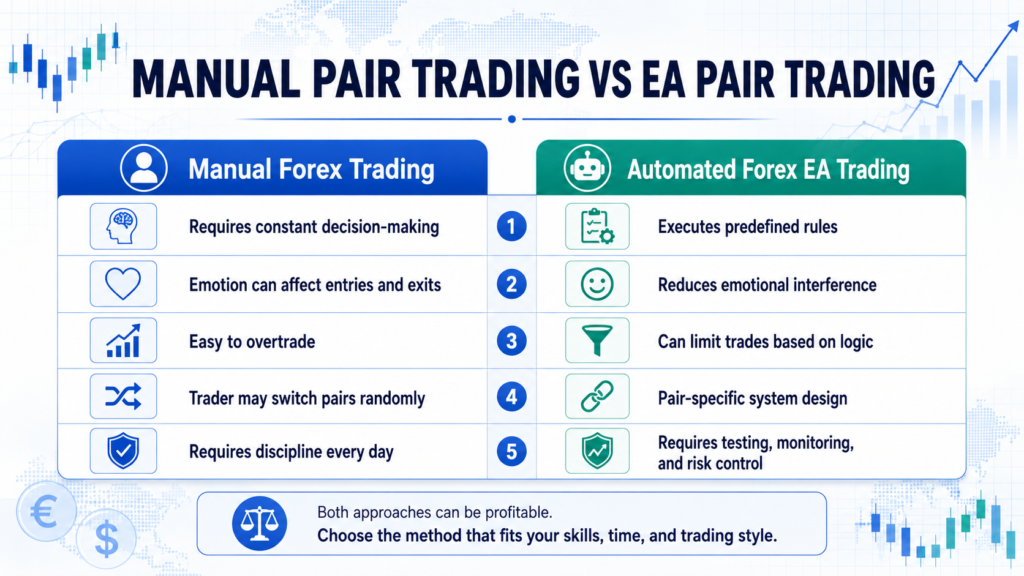
For traders who struggle with manual decision-making, a rules-based EA can help reduce emotional mistakes such as revenge trading, overtrading, moving stop losses, or increasing lot size after a loss. Automation does not remove risk, but it can help enforce consistency when used responsibly.
Best Practices for Trading Currency Pairs
Before trading any forex pair, use a structured checklist:
- Know the pair type
Is it a major, minor, exotic, cross, or commodity pair? - Check the spread
A wide spread can damage short-term strategies. - Understand the drivers
EURUSD reacts heavily to ECB, Fed, inflation, and dollar flows. GBPUSD reacts to UK data, Bank of England policy, and US dollar strength. - Respect session timing
EURUSD and GBPUSD are usually most active during London and New York market hours. - Use sensible position sizing
The same lot size can carry different risk depending on the stop-loss distance and pair volatility. - Avoid major news surprises
High-impact data can cause spread widening, slippage, and sharp price spikes. - Test before trading live
Strategy Tester and demo trading are essential, especially before using an EA on real money.
Useful Resources for Further Learning
- eToro Academy: Currency Pairs Guide — beginner-friendly explanation of base currency, quote currency, major pairs, minor pairs, exotic pairs, commodity pairs, and cross pairs.
- BIS Triennial Central Bank Survey 2025 — official global FX turnover data and currency market structure.
- BabyPips Currency Pair Education — accessible beginner education on major pairs, crosses, and exotic pairs.
- CFTC Forex Risk Warning — important reminder that retail forex trading is highly risky, especially when leverage is involved.
- Nexus Forex Trading EA Page — learn more about the EURUSD and GBPUSD MT4 EA, risk-first automation, and current product access.
Final Thoughts: Master the Pair Before You Trade the Market
Currency pairs are not just symbols on a chart. Each pair has its own behaviour, cost structure, volatility profile, news sensitivity, and trading rhythm. EURUSD is not GBPJPY. GBPUSD is not USDTRY. EURGBP is not USDCAD.
The more you understand the pair you trade, the better your decisions become. Beginners often make the mistake of jumping between too many markets. A smarter approach is to specialise, study a few pairs deeply, track how they behave, and build a repeatable trading process around them.
For many traders, EURUSD and GBPUSD are strong starting points because they combine liquidity, opportunity, market coverage, and practical execution conditions. That is also why Nexus Forex Trading focuses on these pairs for its MT4 automated trading solutions.
Ready to trade EURUSD and GBPUSD with a focused, rules-based MT4 Forex EA?
Join Nexus Forex Trading Free today and get access to automated EURUSD and GBPUSD trading tools built around structured execution, risk-first settings, and disciplined pair selection.