If you’ve ever watched the EUR/USD spike 80 pips in 60 seconds and wondered why, the answer almost certainly lives inside the economic calendar. Yet for many retail traders, this tool remains underused, misunderstood, or flat-out ignored — and that’s a costly mistake.
In this guide, we’ll break down everything you need to know about the Forex economic calendar: what it is, how to read it, which events matter most, and how to build a disciplined trading strategy around it. Whether you’re brand new to Forex or looking to sharpen your edge, this is the one reference you’ll keep coming back to.
What Is a Forex Economic Calendar?
A Forex economic calendar is a real-time scheduling tool that displays upcoming economic data releases, central bank decisions, government reports, and other market-moving events — organised by date, time, currency, and expected impact.
Think of it as the heartbeat monitor of the global economy. Every time a major piece of data is published — whether that’s a US Non-Farm Payrolls report, a Bank of England interest rate decision, or a German ZEW Economic Sentiment reading — the Forex market reacts. Prices move. Spreads widen. Volatility surges. Traders who know these events are coming can position themselves intelligently. Those who don’t are often caught off guard.
At its core, the economic calendar answers three critical questions:
- What economic event is being released?
- When is it happening?
- How much impact is it likely to have on the market?
Why the Economic Calendar Is Essential for Forex Traders
Forex is the world’s largest financial market, with over $7.5 trillion in daily trading volume (BIS 2022 Triennial Survey). Unlike stocks — which are driven largely by company earnings — currency pairs are driven primarily by macroeconomic forces: inflation, employment, GDP growth, interest rates, and trade flows.
When these economic indicators are released, they often tell the market whether a central bank is likely to raise, cut, or hold interest rates. Since interest rate differentials are the single biggest driver of currency prices, any data that hints at a future rate change can spark massive price movements.
Here’s a simple example to illustrate: On 20 April 2026, Canada releases its Inflation Rate YoY figure for March. The previous reading was 1.8%, and the market consensus forecast is 2.5%. If the actual figure comes in at, say, 3.1% — significantly above both the prior reading and the consensus — traders would immediately price in a higher likelihood of a Bank of Canada rate hike. That means CAD strengthens, and pairs like USD/CAD drop sharply, often within seconds of the release.
That’s the power of economic data — and that’s why the economic calendar is not optional. It is fundamental.
How to Read a Forex Economic Calendar
Before you can trade economic events effectively, you need to understand what you’re looking at. Here’s a breakdown of the key columns you’ll find on any professional economic calendar:
Date & Time
Events are listed with their exact release time, typically in UTC or your local timezone. This tells you precisely when to be alert and ready. Missing the timing by even a few minutes can mean entering a trade after the bulk of the move has already happened.
Currency
Each event is tagged with the currency it affects — USD, EUR, GBP, JPY, CAD, AUD, NZD, CHF, etc. A USD event primarily impacts all USD pairs: EUR/USD, GBP/USD, USD/JPY, USD/CAD, and so on.
Event Name
This is the name of the economic report or announcement. Examples include:
- Non-Farm Payrolls (NFP) — US employment
- Consumer Price Index (CPI) — inflation measure
- GDP Growth Rate — economic output
- Interest Rate Decision — central bank policy
Impact Level
Most calendars colour-code events by expected market impact: Low (green), Medium (yellow/orange), High (red). High-impact events are the ones that most frequently cause sharp price spikes and should never be ignored.
Three Key Numbers: Previous, Forecast (Consensus), Actual
| Column | What It Means |
| Previous | The last published reading for this indicator |
| Consensus / Forecast | The average expectation of analysts and economists |
| Actual | The real figure released at the scheduled time |
The magic — and the volatility — happens in the gap between the consensus and the actual. If markets have already priced in the expected number, a result that matches the forecast often produces minimal movement. But when the actual diverges sharply from the consensus, the market reprices rapidly, and that’s where major trading opportunities (and risks) live.
The Most Market-Moving Economic Events in Forex
Not all economic releases are created equal. Here are the events that consistently generate the biggest moves across major currency pairs:
🇺🇸 US Dollar (USD) — The King of Catalysts
Because the USD is involved in approximately 88% of all Forex transactions, American data dominates the economic calendar. Watch these closely:
Non-Farm Payrolls (NFP) — Released the first Friday of every month, NFP shows how many jobs were added or lost in the US economy. It’s arguably the most anticipated event on the entire Forex calendar and routinely causes 50–150 pip swings in EUR/USD and GBP/USD within minutes of release. 📎 Learn about NFP on Investopedia
Federal Reserve Interest Rate Decision — The Fed meets eight times a year to decide on interest rates. Each decision, plus the accompanying statement and press conference from the Fed Chair, can shift entire currency pairs by hundreds of pips. 📎 Follow Fed decisions at FederalReserve.gov
Consumer Price Index (CPI) — The primary inflation measure in the US. As inflation has dominated global monetary policy in recent years, CPI releases carry enormous weight. A hotter-than-expected reading typically strengthens the USD.
Retail Sales — Measures consumer spending, which drives about 70% of the US economy. A strong reading suggests economic resilience and can boost the dollar.
Initial Jobless Claims — Released weekly every Thursday, this is one of the most frequent high-impact data points. It provides a near-real-time read on US labour market health.
🇬🇧 British Pound (GBP) — The Volatile One
GBP pairs like GBP/USD and EUR/GBP are known for wide swings during UK data releases:
- Bank of England (BoE) Rate Decision & Minutes
- UK CPI (Inflation Rate YoY/MoM) — For example, on 22 April 2026, the UK releases its March CPI figures, with the prior reading at 3.0% and the consensus at 3.3%. Any deviation can significantly move GBP pairs.
- UK Employment & Claimant Count — Released on 21 April 2026 alongside average earnings data, these figures give the BoE critical information about wage-driven inflation.
- UK Retail Sales — Due 24 April 2026, showing month-on-month and year-on-year consumer spending trends.
📎 UK economic data official source: ONS
🇪🇺 Euro (EUR) — The Data-Dense Currency
Given that the Eurozone spans 20 nations, the EUR economic calendar is packed. Key events include:
- ECB Interest Rate Decision — The European Central Bank’s monetary policy is a primary driver of EUR/USD.
- ECB President Speeches — Watch the calendar for ECB President Lagarde speeches (such as those scheduled for 20 and 22 April 2026). Even informal remarks can shift EUR pairs significantly.
- ZEW Economic Sentiment — A forward-looking survey of institutional investors in Germany, considered one of the most reliable leading indicators for the Eurozone economy. On 21 April 2026, the German ZEW is forecast at -10, compared to the prior -0.5 — a huge drop that could pressure the Euro.
- German Ifo Business Climate — Released on 24 April 2026, this is another key barometer of European economic health.
- Eurozone CPI (Inflation) — Critical for ECB policy expectations.
📎 ECB economic data: ecb.europa.eu
🇯🇵 Japanese Yen (JPY) — The Safe-Haven Mover
JPY pairs (USD/JPY, EUR/JPY, GBP/JPY) tend to move dramatically during risk-off events and Bank of Japan decisions. On 24 April 2026, Japan releases its Inflation Rate YoY for March — currently at 1.3% versus a forecast of 1.5%. Any upside surprise here could be a major catalyst for the BoJ to move toward policy normalisation, which would strengthen JPY.
🇨🇦 Canadian Dollar (CAD) — Oil’s Currency
CAD is heavily influenced by oil prices, but economic data still matters enormously. On 20 April 2026, Canada publishes multiple inflation readings — including CPI Common YoY (prior 2.4%, forecast 2.9%) and CPI Trimmed-Mean YoY — all rated as High Impact. These releases directly inform Bank of Canada rate decisions and can cause significant USD/CAD volatility.
Understanding Impact Levels: Low, Medium, and High
One of the most practical features of a good economic calendar is the impact rating system. Here’s how to think about each level:
High Impact (Red) — These are the events that move markets. Always be aware of them before entering a trade. During a high-impact release, spreads widen dramatically, slippage increases, and stop-losses can be triggered. Examples: NFP, CPI, interest rate decisions, GDP, retail sales data. Avoid trading 15 minutes before and during the initial release unless you are specifically trading the news.
Medium Impact (Orange/Yellow) — These events matter and can cause noticeable price moves, especially if they deviate significantly from expectations. Examples: housing data, trade balance figures, manufacturing surveys, central bank speeches. Monitor these and be cautious with open positions.
Low Impact (Green) — These rarely cause major moves on their own. However, if multiple low-impact releases point in the same direction, or if a low-impact event surprises massively, they can contribute to a broader move. Examples: minor auction results, lower-tier sentiment surveys.
Real-World Economic Calendar Strategy: A Week in April 2026
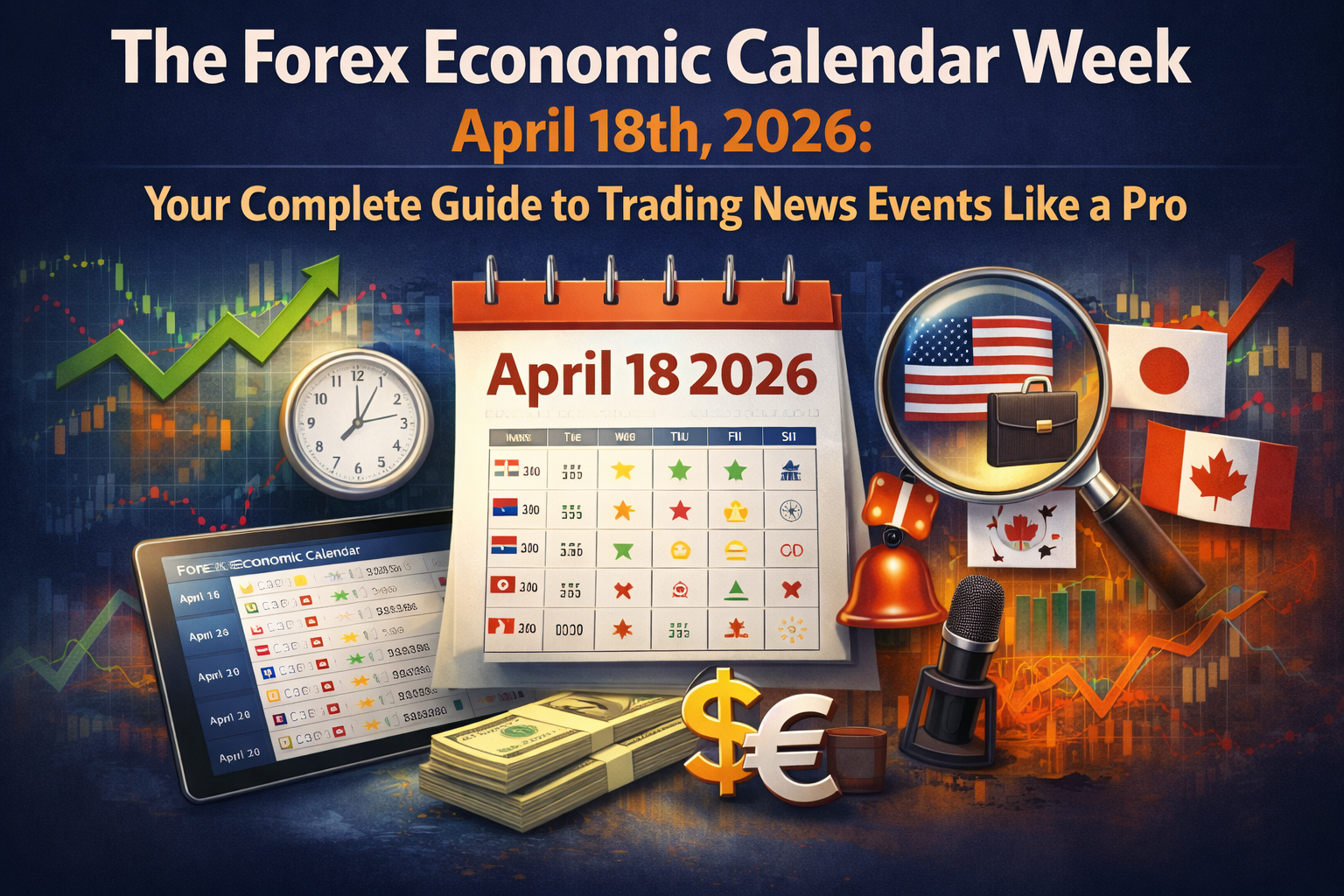
Let’s walk through a real trading week using the economic calendar as our guide. Looking at the week of 19–25 April 2026:
Sunday 19 April — NZD Balance of Trade releases during the Asian session. The previous figure was -NZ$0.257B, with the consensus forecasting a surplus of NZ$0.27B — a major swing. NZD pairs could be in play at open.
Monday 20 April — Canada dominates with six separate inflation metrics hitting at 13:30 UTC — all rated Medium to High. This is the day’s primary event. Expect USD/CAD and CAD/JPY to be highly reactive.
Tuesday 21 April — A jam-packed day: UK employment data at 07:00 (High impact), German ZEW at 10:00 (High), and US Retail Sales at 13:30 (High). This is a potential triple-volatility day. Traders need to be particularly disciplined — multiple high-impact events in sequence can create whipsaw conditions.
Wednesday 22 April — UK CPI (High), UK PPI, ECB Lane speech, and EIA oil inventory data. GBP pairs and crude-linked CAD will be in focus.
Thursday 23 April — US Initial Jobless Claims and Continuing Claims at 13:30 (all High impact), alongside multiple Canadian data points and UK CBI industrial surveys.
Friday 24 April — Japan CPI (High, 00:30), UK Retail Sales (High, 07:00), German Ifo Business Climate (High, 09:00), and US Michigan Consumer Sentiment (High, 15:00). A big ending to a big week.
A trader who does not consult the calendar before each session on this week risks being ambushed by volatility on virtually every day.
Pro Tips for Using the Economic Calendar Effectively
1. Plan Your Week Every Sunday
Spend 15–20 minutes each Sunday reviewing the week’s high and medium-impact events. Note the dates, times, and currencies affected. Block these out in your trading journal.
2. Compare Actual vs. Consensus — Not Just Directional
A rising number isn’t always bullish. Context matters. If the US unemployment rate rises from 4.0% to 4.1%, but the market expected 4.3%, the dollar might actually strengthen because the reading was better than feared.
3. Watch for Revisions
Previous figures are often revised when new data comes in. A downward revision to last month’s strong NFP can be as bearish as a weak current release.
4. Factor in Central Bank Meeting Cycles
Knowing when the next Fed, ECB, or BoE meeting is — and what data they need to see before acting — gives you a framework for interpreting each release in its proper context.
5. Use Multiple Calendar Sources
Cross-reference calendars to catch any discrepancies. Recommended resources:
- 📎 Investing.com Economic Calendar
- 📎 Myfxbook Economic Calendar (the source for this week’s data featured above)
- 📎 Forex Factory Calendar
- 📎 DailyFX Economic Calendar
6. Set Alerts
Top-tier economic calendars allow you to set email or push notifications for specific events. Never be caught off guard by a scheduled release again.
7. Avoid Trading Blind Into High-Impact Events
If you have an open position and a high-impact event is approaching, consider reducing your position size or tightening your stop-loss in advance. The risk-reward profile changes dramatically during news volatility.
Economic Calendar and Automated Trading (EAs/Bots)
For traders using automated trading systems — Expert Advisors (EAs) or Forex bots — the economic calendar is even more critical. Most professional EAs include news filter settings that automatically pause trading during high-impact releases to avoid being whipsawed by erratic price action.
When selecting or configuring an EA, always check whether it has:
- A built-in economic calendar news filter
- Configurable impact thresholds (Low/Medium/High)
- Time-based pausing around scheduled releases
An EA that trades blindly through a NFP or CPI release without any protection can give back weeks of profit in minutes. The best automated systems respect the calendar as rigorously as manual traders should.
Common Mistakes Traders Make with the Economic Calendar
Ignoring it entirely — Far too common. Even if you trade technically, the calendar tells you when to reduce risk.
Trading based on direction alone — “CPI is higher, so USD goes up” isn’t always correct. The market’s reaction depends on what was already priced in.
Overleveraging into news — High volatility + high leverage = account-blowing risk. News events are not the time for maximum exposure.
Missing timezone conversions — Event times are typically listed in the calendar’s default timezone. Double-check your local time to avoid watching the clock while EUR/USD has already moved 100 pips.
Treating all high-impact events equally — NFP and an interest rate decision are very different beasts. Learn the nuance of each major release.
Summary: The Economic Calendar Is Your Edge
The Forex market rewards preparation. The economic calendar is the most accessible, free, and powerful preparation tool available to every trader — from a beginner on their first week to a 20-year veteran. It tells you where the landmines are, where the opportunities may emerge, and how to size your risk appropriately for any given day.
Combine the economic calendar with solid technical analysis, disciplined risk management, and — if you choose — a well-configured automated trading system, and you have the foundation of a professional-grade trading approach.
The traders who outperform don’t necessarily have better chart patterns or secret indicators. They simply prepare better. The economic calendar is where that preparation begins.
🚀 Ready to Take Your Forex Trading to the Next Level?
Understanding the economic calendar is one thing. Having the right tools to act on that knowledge is another. At Nexus Forex Trading, we’ve built a powerful EUR/USD and GBP/USD EA Bot that trades these volatile, high-liquidity pairs with precision — with built-in risk management designed to navigate exactly the kind of economic event-driven markets we’ve discussed throughout this guide.
Whether you’re a manual trader looking for an edge or want to automate your strategy on the world’s most traded currency pairs, Nexus Forex Trading has you covered.
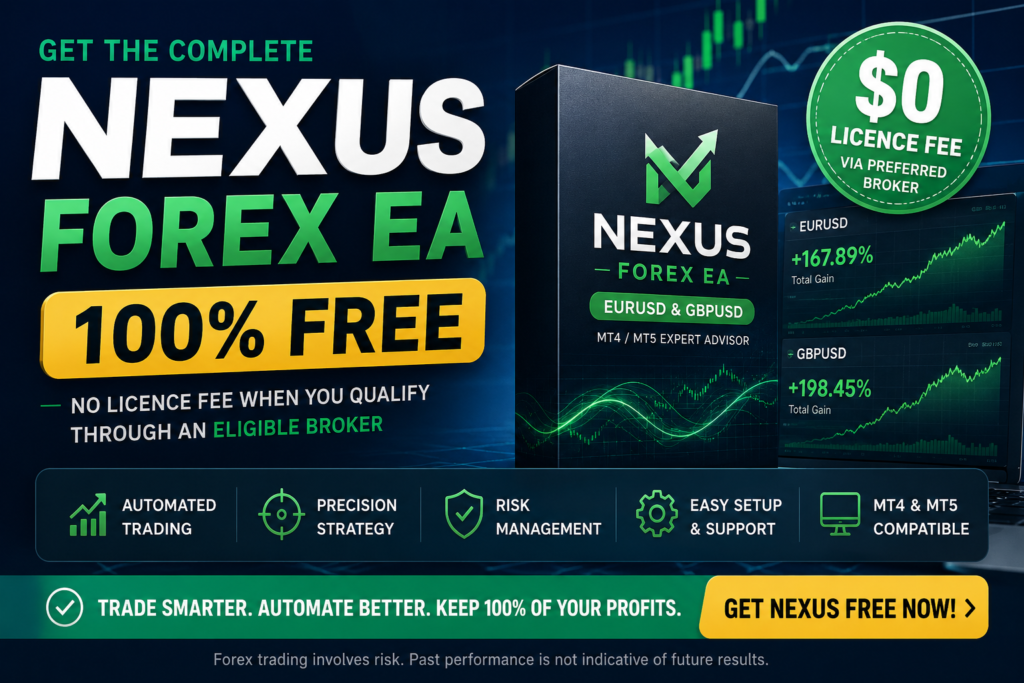
Don’t let another high-impact news release catch you flat-footed. Join thousands of traders already using Nexus to trade smarter, not harder.
Disclaimer: Forex trading involves significant risk of loss. Past performance is not indicative of future results. Always trade responsibly and never risk more than you can afford to lose. This article is for educational purposes only and does not constitute financial advice.