A lot of prop traders do not lose their accounts because they cannot find entries.
They lose them because their stop loss strategy prop firm trading rules do not match the way prop firms actually measure risk.
That distinction matters more than most traders realize. A stop that looks sensible on the chart can still be a bad stop if it clashes with your firm’s daily loss rule, maximum loss rule, or trailing drawdown model. For example, FTMO’s current 1-Step rules calculate Maximum Daily Loss from the prior midnight balance minus 3% of initial simulated capital, and its Maximum Loss amount is 10% of initial simulated capital. E8’s Daily Drawdown uses a fixed dollar amount based on the initial balance, but resets the daily loss level from the new day’s starting balance. Topstep, meanwhile, uses different loss frameworks including a Maximum Loss Limit that trails profits in certain accounts, and its own education highlights how intraday trailing drawdown can close an account on a normal pullback.
That is why stop placement in prop firm trading is not just technical analysis. It is technical analysis filtered through rule design.
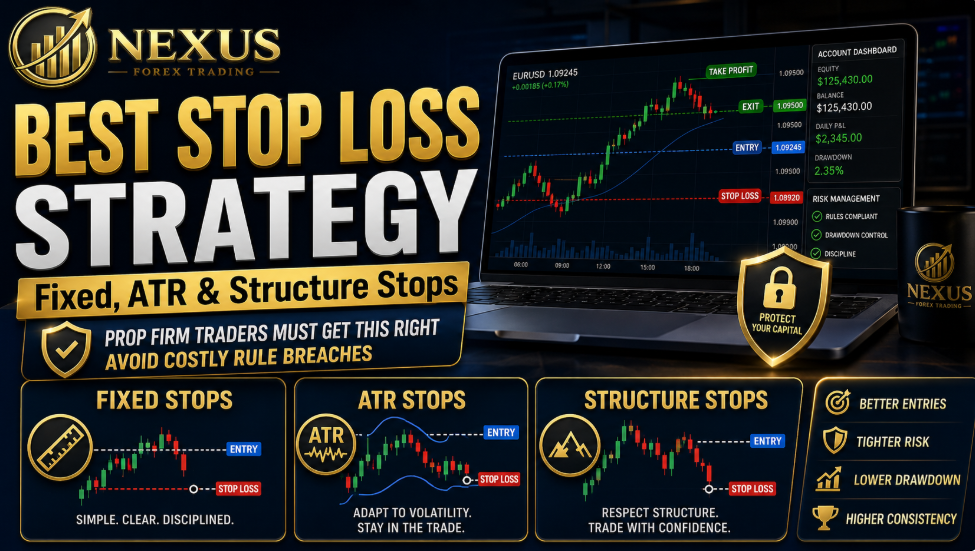
This guide breaks down the three most useful stop loss approaches for prop traders:
- fixed stops
- ATR-based stops
- structure-based stops
It also explains when not to trail, because trailing too early is one of the fastest ways to sabotage otherwise good trades.
Why stop loss logic matters more in prop firm trading
In a personal account, a bad stop is painful.
In a prop account, a bad stop can be terminal.
That is because many firms track risk at the account level, not just the trade level. FTMO’s published rules say equity includes open positions, commissions, and swaps when calculating Maximum Daily Loss and Maximum Loss. E8 says a permanent daily drawdown violation can occur if either equity or balance falls below the calculated loss level at any point during the day. Topstep’s help center states that if your Net P&L hits or exceeds the Maximum Loss Limit, the account can be closed.
That means your stop loss must do more than define where the trade idea is wrong. It also needs to:
- protect your daily loss buffer
- keep you safely above the account breach level
- work within your firm’s execution and drawdown model
A trader can be “right” about the idea and still fail the account if the stop logic is too loose, too reactive, or badly timed.
The first rule: build your stop around the prop firm’s loss model
Before choosing fixed, ATR, or structure stops, work backward from the rules.
Ask these five questions first:
1) Is daily drawdown fixed or dynamic?
FTMO resets its Maximum Daily Loss each midnight using the prior balance minus a fixed amount equal to 3% of initial simulated capital. E8 uses a fixed dollar amount based on 4% of the initial balance and resets the loss level from the new day’s starting balance.
2) Is maximum loss static or trailing?
Topstep says its Maximum Loss Limit can trail with profits made in the account, which means the floor can move up as the account grows.
3) Does the firm use equity or balance?
That matters because floating drawdown can count before the trade is closed. FTMO and E8 both explicitly reference equity in their rule explanations.
4) Is trailing drawdown measured intraday or end of day?
Topstep’s education notes that intraday trailing drawdown can fail a trader even while a trade is still up, whereas end-of-day drawdown gives more room for normal pullbacks.
5) How much buffer do you really have?
If your daily cap is 3% or 4%, your usable risk is not the full number. Spread, slippage, and open-profit retracement all eat into that room.
Once you know the rule set, your stop loss strategy starts making sense.
Fixed stop loss: simple, clean, and often underrated
A fixed stop means every trade uses the same stop distance in pips, points, or ticks.
Examples:
- 15-pip stop on EUR/USD
- 20-pip stop on GBP/USD
- 30-point stop on NASDAQ
When fixed stops work best
Fixed stops are often a good fit when:
- you trade the same pair repeatedly
- your setup has a very consistent volatility profile
- you are running a simple, rules-based model
- your prop firm’s daily drawdown is tight and you need predictable risk
For prop traders, the biggest benefit is consistency. If every stop is 15 pips and every trade risks 0.25% or 0.5%, you can forecast your worst-case day much more accurately.
Example
Suppose your prop account has a practical daily risk budget of 1% even though the firm technically allows more.
You take a maximum of 3 trades per day.
That means each trade may need to stay around 0.33% risk or less.
A fixed stop helps because your lot size formula remains consistent:
Position size = cash risk / stop distance
When fixed stops fail
The weakness is obvious: markets do not move with fixed volatility.
If EUR/USD is calm, a 15-pip stop may be fine. If CPI day hits and range expands sharply, the same 15-pip stop can become noise. That is why fixed stops are strongest in stable conditions and weakest in event-driven markets.
Best use case: session-based scalping, very repeatable intraday setups, or evaluation phases where predictability matters more than flexibility.
ATR stop loss: one of the best tools for prop traders
If you want a stop that adapts to volatility, ATR is one of the best places to start.
Fidelity defines Average True Range (ATR) as the average of true ranges over a specified period and notes that it measures volatility, taking gaps into account. Fidelity also notes that 14 periods is the most common setting and that expanding ATR signals rising volatility.
Why ATR stops fit prop firm trading so well
ATR stops solve a major prop problem: they stop you from using the same stop size in two completely different market conditions.
Instead of saying:
- “I always use 15 pips”
you say:
- “I use 1.5 x ATR”
- or “I use 2 x ATR during higher-volatility sessions”
That makes your stop responsive to the actual environment.
ATR stop examples
If EUR/USD on the 15-minute chart has a 14-period ATR of 8 pips:
- 1 x ATR stop = 8 pips
- 1.5 x ATR stop = 12 pips
- 2 x ATR stop = 16 pips
If ATR expands to 14 pips later in the day:
- 1.5 x ATR stop becomes 21 pips
That wider stop may keep you in the trade, but it also means you must reduce size to keep risk constant.
A practical prop-friendly ATR framework
A useful framework looks like this:
- Normal intraday setup: 1.2 to 1.5 x ATR
- Trend trade / higher timeframe swing: 1.8 to 2.5 x ATR
- High-impact news day: either widen the ATR multiple and cut size, or do not trade
Why ATR beats fixed stops in volatile weeks
If your prop firm counts equity intraday, tight static stops can get clipped repeatedly. ATR gives the trade more room when the market genuinely deserves more room.
Best use case: traders who want volatility-aware stops, especially on EUR/USD, GBP/USD, indices, or news-sensitive pairs.
Structure stops: the most logical stop, if you define structure properly
A structure stop is placed behind a real market reference point:
- below a swing low
- above a swing high
- beyond support or resistance
- outside a range boundary
Fidelity explains that when support or resistance is broken, its role often reverses. In practice, that makes structure levels useful reference points for invalidation.
Why structure stops are powerful
A structure stop says:
“I am wrong if price breaks this level.”
That is far better than choosing a random pip distance.
Example
You buy EUR/USD on a pullback in an uptrend.
The recent swing low sits 18 pips below entry.
Instead of placing a 10-pip stop because it feels tighter, you place the stop a few pips below the swing low.
That stop now matches the chart logic.
The prop trading challenge with structure stops
Structure stops can be excellent, but they create two problems in prop trading:
- They can be wide
If the swing point is far away, your position size has to shrink materially. - They can be inconsistent
One trade may need 12 pips, another 28 pips, another 40 pips. That makes daily risk planning harder unless your sizing model is disciplined.
Best practice
Use structure stops with one extra filter:
- add a small volatility or spread buffer
- then check that the final stop still fits your per-trade risk budget
Best use case: swing trades, breakout-retest entries, higher-timeframe setups, and traders who prioritize logic over frequency.
Which stop type fits which prop trading style?
Fixed stops are best for:
- scalpers
- one-pair specialists
- evaluation phases
- traders needing very stable daily risk
ATR stops are best for:
- active intraday traders
- volatility-aware systems
- traders who want consistency across changing conditions
Structure stops are best for:
- swing traders
- breakout/retest traders
- traders who base entries on chart context rather than mechanical distance
For many prop traders, the best answer is not one method forever. It is a decision tree:
- use structure first
- sanity-check it against ATR
- reject the trade if the stop is too wide for the rule set
That is often the most professional way to do it.
When NOT to trail your stop
This is where many traders sabotage good trades.
Trailing sounds smart because it feels safer. But in prop firm trading, trailing too early often creates worse outcomes, not better ones.
Investor.gov notes that stop orders become market orders when triggered, that execution price is not guaranteed to match the stop price, and that short-term intraday price moves can trigger stop and trailing stop orders unexpectedly. It also notes that trailing stops can be activated by short-term fluctuations if the trailing distance is chosen poorly.
Do not trail too early in these situations:
1) When the trade has not earned enough room
If you trail to breakeven too quickly, you often convert a valid trade into a scratch trade.
A simple rule:
- do not trail before the trade has achieved at least 1R or reached a meaningful structure break
2) In choppy or mean-reverting conditions
Trailing works best in clean trends.
In chop, trailing stops usually feed the market easy liquidity.
3) Around major news
On high-impact releases, stops may slip and short-term spikes can trigger a trailing stop before the real move develops. Investor.gov’s warning on short-term intraday triggers applies here in principle, even though trading venue mechanics vary.
4) If your prop firm uses intraday trailing drawdown
Topstep’s educational example shows how an intraday trailing rule can punish a normal pullback in an otherwise winning trade. In that environment, an overly aggressive trailing stop can compound the problem by cutting your position at the exact moment you needed breathing room.
5) When the original thesis is still intact
If price is simply retesting structure, there may be no logical reason to tighten the stop yet.
Better alternatives to aggressive trailing
Instead of trailing immediately, consider:
- moving to breakeven only after 1R
- taking partial profits at the first target
- trailing behind structure, not candle-by-candle noise
- using a realized-profit trailing model in your own risk planning, not an unrealized one
Topstep’s help center distinguishes between realized and unrealized trailing for daily loss settings, and that distinction is useful conceptually for traders too: realized gains are more stable than floating gains.
A practical stop loss strategy prop firm trading framework
If you want a simple framework you can actually use:
Option A: intraday prop framework
- Risk per trade: 0.25% to 0.5%
- Stop type: 1.2 to 1.5 x ATR
- Trail: only after 1R and only behind structure
- Max trades per day: 2 to 4
- Stop trading after 2 losses
Option B: swing-style prop framework
- Risk per trade: 0.25% to 0.4%
- Stop type: structure stop with ATR/spread buffer
- Trail: only after a confirmed higher low or lower high
- Cut size if holding through major data
Option C: evaluation-phase framework
- Risk per trade: small and fixed
- Stop type: fixed or ATR
- Objective: protect the account first, pass second
The best stop is not the tightest one.
It is the one that keeps the trade valid and keeps the account alive.
Good resources to study this further
For traders who want stronger stop logic and better risk control, these are worth reading:
- FTMO’s published trading objectives and loss-limit explanations
- E8’s daily drawdown explanation for reset logic
- Topstep’s drawdown and trailing-loss resources
- Fidelity’s guides on ATR and support/resistance
- Investor.gov’s bulletin on stop, stop-limit, and trailing stop orders
Final takeaway
The real edge in stop loss strategy prop firm trading is not finding a clever stop.
It is matching your stop logic to:
- your setup,
- the current volatility,
- and the exact loss model your prop firm uses.
Fixed stops are excellent for consistency.
ATR stops are excellent for volatility.
Structure stops are excellent for logic.
But the real skill is knowing when to use each one and when not to trail too early.
If you want a more disciplined, risk-first approach to forex and prop-style trading, join Nexus Forex Trading. We focus on steady execution, controlled drawdown, and practical trading frameworks designed for real market conditions, not fantasy results. Get an Additional 50% Discount using code: nexus50fx