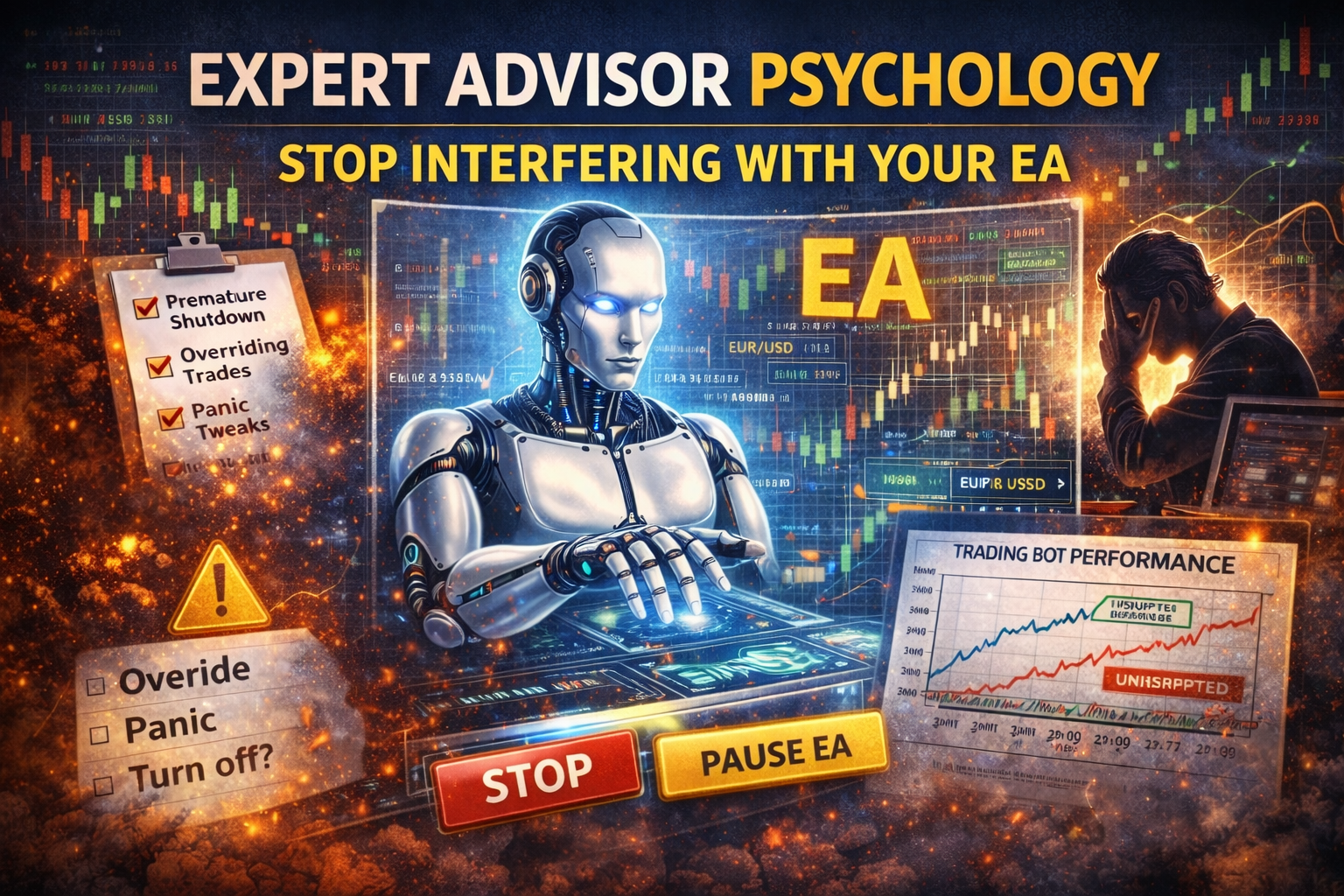
If you’ve ever installed an EA, watched it take a couple of losses, and then thought, “I’ll just pause it for a bit”—you already know the pain. The market moves, your EA recovers (without you), and suddenly you’re left with the worst possible outcome: you took the drawdown but missed the comeback. That moment isn’t a strategy problem. It’s Expert Advisor psychology—and it’s the reason many traders never get the full value from automated forex trading.
Automation promises emotional distance, but it doesn’t remove emotion. It relocates it. Instead of feeling fear when you click “Buy,” you feel fear when you watch the bot buy. Instead of overtrading with your finger, you overtrade with your settings.
This article is about protecting the one thing that matters in any forex EA strategy: expectancy. If your EA has an edge, your job is not to “help” it trade better. Your job is to stop yourself from interrupting the math.
Why traders emotionally interfere with their EA’s trades
Most interference comes from a few predictable psychological needs:
1) The urge to regain control
A bot taking trades while you do nothing can feel like helplessness—especially during drawdowns. Many traders interpret inactivity as negligence, so they “do something” to reduce discomfort. That “something” is usually harmful.
As one trading psychology coach puts it: automation removes certain execution emotions, but it doesn’t remove deeper patterns like fear, impatience, greed, and doubt—they still show up when the results aren’t immediate.
2) Action bias (the need to be useful)
When P/L turns red, your brain looks for a lever. Pausing the EA, reducing risk “just for now,” or tweaking inputs feels responsible. But “calm-looking decisions” can still be emotionally driven—because with bots, the impulse arrives as a rational thought rather than panic.
3) Recency bias (last week becomes the truth)
A few losing days can override months of performance in your mind. You start believing the EA is “broken” simply because the recent sample is noisy. But edges don’t show up in micro-samples. They show up over distributions.
4) Identity and self-worth attached to outcomes
If a red day feels like a personal verdict, you’ll intervene to protect your ego. Detachment from daily results becomes non-negotiable in algorithmic trading mindset—because your EA’s value is not “today’s P/L.” It’s whether it behaves within expected parameters.
The psychological traps that kill automated trading performance
Here are the big ones that quietly destroy trading bot performance, even when the EA itself is solid.
Trap A: Overriding trades (a.k.a. “just this one time”)
Overriding is seductive because it sometimes “works.” You skip one losing trade, feel smart, and now your brain wants to repeat it. The problem is you’re selectively avoiding losses without knowing which losses are required for the edge to play out.
Once you start overriding, you create the worst possible feedback loop: results become ambiguous. TradingView’s AI-trading psychology breakdown calls this “confusion”—you can’t tell whether performance is from the system or your meddling.
Trap B: Premature shutdown during normal drawdowns
Many traders don’t blow up because of a bad system—they sabotage a good one at the worst moment by stopping it after a string of losses. A positive-expectancy system only produces results if you allow it to play out.
Binance’s bot-psychology guide hits the same point: drawdown is not failure, and constant interruption breaks the logic the bot is built on.
Trap C: Panic tweaks and over-optimization
Checking too often creates anxiety. Anxiety creates changes. Changes destroy consistency. Binance explicitly warns that overchecking leads to overtrading, and recommends a fixed review schedule (e.g., weekly) instead of staring at charts.
Trap D: Unrealistic expectations
If you secretly expect smooth equity curves or daily gains, you’ll intervene the moment reality looks messy. One source notes that many traders wrongly expect extreme daily ROI, while more sustainable bot expectations are typically measured monthly rather than intraday.
“Calibrated trust”: the mindset that keeps you hands-off (without being naive)
The solution isn’t blind faith (“the bot knows best”). And it isn’t micromanagement (“I’ll override whenever I want”). It’s calibrated trust—a middle path where you trust the system because you understand it and you intervene only under pre-written conditions.
A practical definition:
- You understand how the EA makes decisions
- You know its expected win rate, drawdown profile, and typical losing streaks
- You have written rules for when you will and won’t intervene
Think of it as a partnership: the EA follows the rules; you manage the environment and the risk.
How to build trust in a well-backtested system during drawdowns
Trust isn’t a feeling. It’s a stack of evidence. Here’s how to build it in a way that holds up when you’re under pressure.
1) Define the EA’s “normal” before you ever go live
Before you hit start, document:
- Expected drawdown range
- Largest historical losing streak
- Worst monthly period in backtests
- Market regimes it struggles in (trendless chop, high-vol spikes, etc.)
This is crucial because when drawdown arrives, your brain asks: “Is this normal?” If you don’t have an answer, your emotions will write one.
2) Switch from “daily P/L thinking” to “systems thinking”
A strong framework from performance coaching is to ask:
“Is the strategy behaving within its historical parameters?” rather than “Why is it losing today?”
That one shift protects you from recency bias and forces you to evaluate reality statistically.
3) Trade small enough that you can sleep
This sounds obvious, but it’s the most effective psychological hack: if position sizing is too big, no mindset trick will save you. TradingView puts it bluntly: trade smaller than you think you should—if you can’t sleep, size is too big.
4) Rename your EA to match the timeframe of its edge
One clever trick from the Binance piece: name your bot something like “60-Day System” to mentally prepare for short-term red.
It sounds simple, but it reframes expectations away from “today must be green.”
A hands-off operating system: rules that stop you from rewriting the plan mid-trade
If your rules only live in your head, your emotions will rewrite them in real time.
So write them down. Here’s a clean structure you can copy:
Your EA Intervention Policy (simple template)
I will NOT intervene when:
- The EA is trading within its designed conditions
- A losing streak is within historical norms
- There are no technical errors
- No extraordinary market event breaks the model assumptions
I WILL intervene only if:
- There’s a platform/connection/data error (missed ticks, execution failures)
- The market breaks outside the EA’s defined operating range
- A major news shock creates conditions the EA wasn’t designed for
- Hard stop conditions are hit (max daily loss, max drawdown, etc.)
Both Binance and TradingView emphasize this “when to step in vs hold steady” distinction—intervene for clear rule breaks, not normal volatility.
Practical mindset strategies to protect your EA’s edge (the part most traders skip)
Strategy 1: Schedule your checking (and treat it like risk control)
Set fixed review windows (e.g., Sunday + midweek). Binance recommends using a check-in schedule instead of constant monitoring.
Why it works: every peek triggers a reaction loop. TradingView makes the same point: check less often and schedule reviews.
Strategy 2: Journal urges, not just trades
Write down the impulse:
“Wanted to stop the EA after 3 losses—didn’t.”
This turns interference into something you can measure and improve, like any other performance metric.
Strategy 3: Separate process from outcome
A core rule from TradingView’s piece:
Good process + bad short-term outcome is still a win. Bad process + good short-term outcome is a landmine.
If you can internalize this, you stop “rewarding” your own interference.
Strategy 4: Replace “hope” with hard stops
Bots don’t decide position size, max drawdown, or capital allocation—you do. Outsourcing execution doesn’t mean outsourcing responsibility.
Set:
- Max daily loss
- Max drawdown
- Max consecutive losses before a review (not a panic shutdown)
The real goal: become an EA operator, not an EA babysitter
Automated forex trading isn’t a shortcut around trading psychology. It’s a stress test for it.
The traders who succeed with EAs aren’t emotionless. They’re structured. They pre-commit to rules, reduce stimulus (constant monitoring), and size appropriately so they can let probability do its job.
Your EA edge only shows up if you let it breathe.
CTA: Want to run EAs the professional way?
If you’re serious about building a calm, rules-based algorithmic trading mindset—and you want access to experienced EA traders, proven frameworks, and a community that treats automated trading like a process (not a gamble)—join Nexus Forex Trading and learn how our best EA traders approach risk, drawdowns, and disciplined execution.