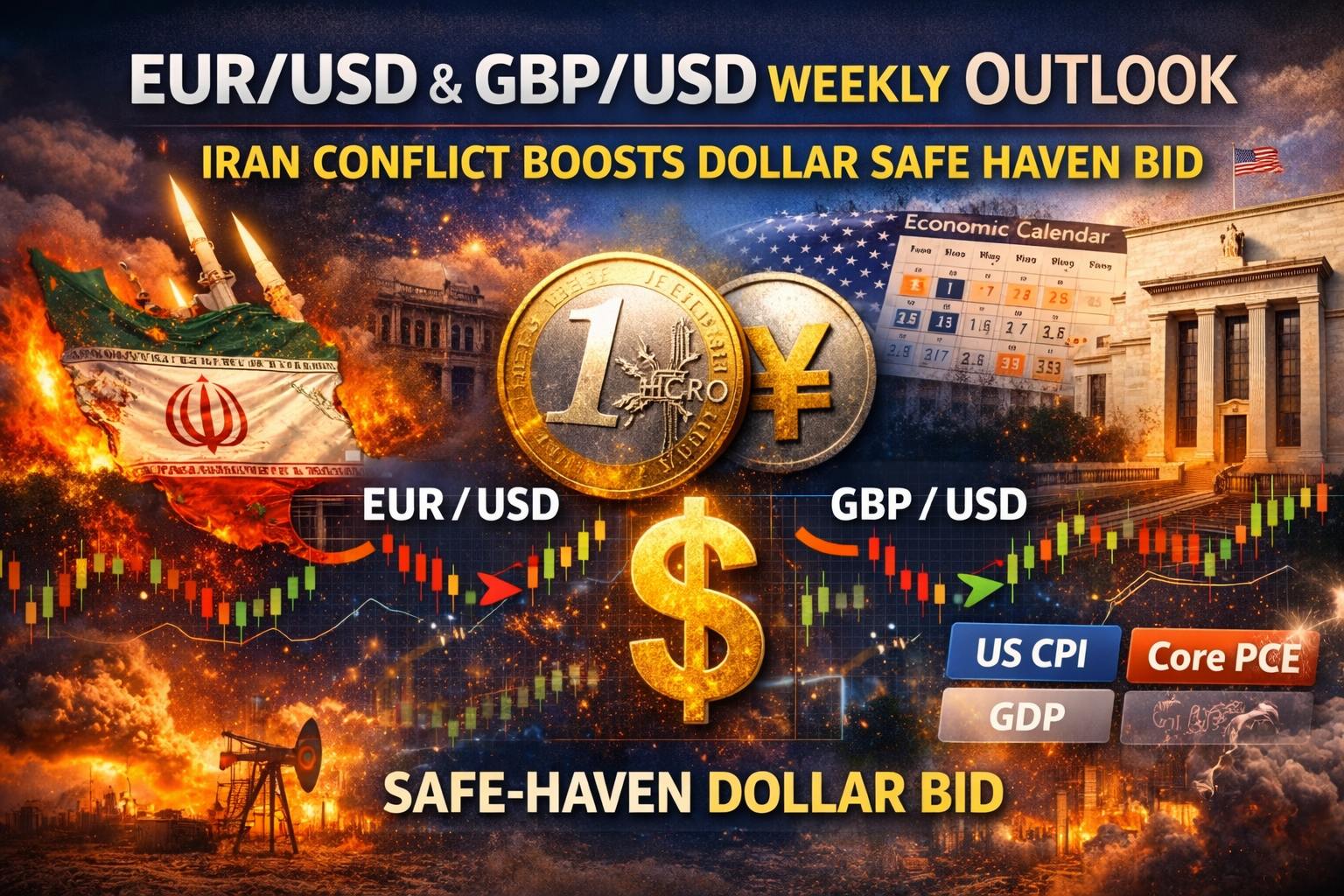
The forex market is heading into the new week with two forces pulling hard on price action: geopolitical escalation around Iran and a high-impact U.S. inflation and consumption data run that can reset rate expectations. When these collide—risk-off flows plus inflation uncertainty—the dollar safe haven bid tends to strengthen, volatility rises, and technical levels break faster than traders expect.
That setup is already visible in how markets ended the week. Reuters reported the U.S. dollar index near 99 and on track for its strongest weekly gain in more than a year, as demand for safe-haven assets rose during the Iran conflict escalation. Investing.com echoed the theme: the dollar softened after a weaker jobs print, but remained set for a strong week because the Middle East war drove haven demand.
For EUR/USD and GBP/USD traders, the key question is simple: does the geopolitical risk premium stay embedded long enough to keep USD supported, or does next week’s data force a pivot?
The Iran conflict’s FX transmission: why it’s USD-positive (even when “risk-off” isn’t clean)
The forex market Iran impact is not just “fear = USD up.” The more durable channel is energy—and energy is what makes this shock particularly uncomfortable for Europe and (to a lesser extent) the UK.
ING’s Chris Turner laid it out clearly: the immediate FX reaction has been relatively contained, but the mix of higher oil and natural gas prices plus questions over Fed easing makes it “far too early” to fight USD strength. ING also flagged that Europe’s TTF natural gas opened sharply higher, and warned the longer energy stays elevated, the bigger the toll on the external accounts of fossil-fuel importers—pressuring the euro in particular.
Reuters added a crucial rates angle: the energy surge is reviving inflation risk and pushing rate-cut expectations out (including for the Fed), while markets also repriced other central-bank paths. In other words, the Iran-driven energy spike doesn’t just hit sentiment—it can delay easing, which is structurally USD-supportive.
Bottom line for traders: if the conflict headlines keep coming and energy remains bid, USD strength can persist even if equities wobble—because the market is repricing the “how fast can central banks cut?” question.
Economic calendar forex: the events that matter most this week
Your calendar has a heavy concentration of catalysts for USD, EUR, and GBP—with U.S. CPI the centerpiece.
Wednesday is the volatility core: Eurozone Retail Sales + ECB signals + US CPI
- Eurozone Retail Sales (High) and ECB Vice President Guindos speech (High) are early tells on the consumer and ECB tone.
- Then the headline risk hits: U.S. CPI (High) + Core CPI (High).
If CPI is hotter than expected, it reinforces the geopolitical/energy inflation story and can extend the dollar safe haven run via higher front-end yields. If CPI surprises lower, the market may try to fade USD—but in a headline-driven war environment, dips can still get bought.
Thursday: BoE communication meets US labor + housing + trade
- BoE Governor Bailey speech (Medium) plus UK housing sentiment (RICS, Medium) can shift GBP expectations.
- The U.S. delivers a cluster: Initial Jobless Claims (High), Housing Starts (High), Building Permits (High), and Goods Trade Balance (High).
In a week where geopolitics is already tightening financial conditions, jobless claims becomes a key “stress gauge.”
Friday: UK hard data day + US Core PCE and growth
- UK prints a dense set including GDP MoM (High), Goods Trade Balance (High), and production data.
- The U.S. follows with Core PCE (High)—the Fed’s preferred inflation measure—plus GDP (High) and Durable Goods Orders (High).
This is the kind of Friday that can set the tone for the next two weeks—especially if the market starts pricing “fewer cuts, for longer.”
EUR/USD forecast: energy shock risk + US CPI puts 1.16 under pressure
Reuters noted EUR/USD around $1.161 and down on the week as the Iran conflict lifted the dollar and energy costs weighed on energy importers. Investing.com similarly framed the euro’s weekly decline as higher energy prices denting Europe’s growth expectations.
From a forward-looking lens, EUR/USD has two main drivers this week:
- Energy terms-of-trade vs. ECB reaction function
ING’s view is that higher energy prices force a reassessment of the euro’s “European recovery” positioning, and that EUR/USD can be pushed back toward the mid-1.15s if de-escalation doesn’t arrive. - US CPI and the “Fed can’t cut” narrative
If CPI or Core CPI prints firm, it reinforces the “energy-driven inflation persistence” theme and can extend USD gains via rate repricing.
Tradeable takeaway: For EUR/USD, treat this as a headline + CPI week. If price is heavy into Wednesday, the higher-probability move is a “CPI breakout continuation” rather than a clean mean reversion—unless geopolitics suddenly cools.
GBP/USD weekly outlook: BoE messaging + UK GDP/trade vs. risk-off USD support
Sterling has been caught in the same crosswinds. Reuters had GBP/USD near $1.336 in the risk-off week. Investing.com highlighted that sterling was still on track for weekly losses, with rising energy prices adding pressure.
For GBP/USD, the week’s structure is clearer:
- Thursday: Bailey’s speech sets the tone on inflation persistence and the appetite to ease.
- Friday: A full UK activity package—GDP MoM (High), trade balances (High), industrial/manufacturing production—is the data gut-check.
If UK data disappoints while the U.S. prints sticky inflation (CPI/Core PCE), GBP/USD can struggle even if it looks “cheap” on a chart—because the market will prioritize USD yield support + risk-off flows.
Tradeable takeaway: GBP/USD is likely to trade as “USD-driven” early week, then become “UK-driven” into Friday. If you only pick one GBP catalyst to plan around, it’s Friday’s GDP/trade/production cluster.
Practical playbook for retail and intermediate traders
- Plan around time windows, not just events. Wednesday’s EU morning + US CPI later is the week’s volatility spine.
- Respect the headline tape. In geopolitical weeks, clean technical setups fail more often; size down and widen invalidation logic.
- Watch energy as a “macro indicator.” If oil/gas stay bid, it’s usually EUR-negative and USD-positive through inflation and trade balance channels.
- Avoid over-trading CPI. Let the first spike settle; many CPI moves reverse once yields choose direction.
- Scenario-map EUR/USD and GBP/USD.
- Hawkish inflation + ongoing conflict → USD supported, EUR/USD/GBP/USD biased lower.
- Softer inflation + de-escalation headlines → USD pullback possible, but likely choppy.